How tech workers are feeling in 2026
One half feels amplified by AI. The other half feels shaken by it.
九个数字,看懂 2026 年科技人的心态裂缝
-
The workforce is splitting in two—amplified by AI or shaken by it.
AI 把职场劈成两半
AI-identity stance was the single strongest predictor of career optimism (β = +0.39).
一个人是被 AI「放大」还是「动摇」,比职级、年龄、公司都更能预测他对工作的感受。
-
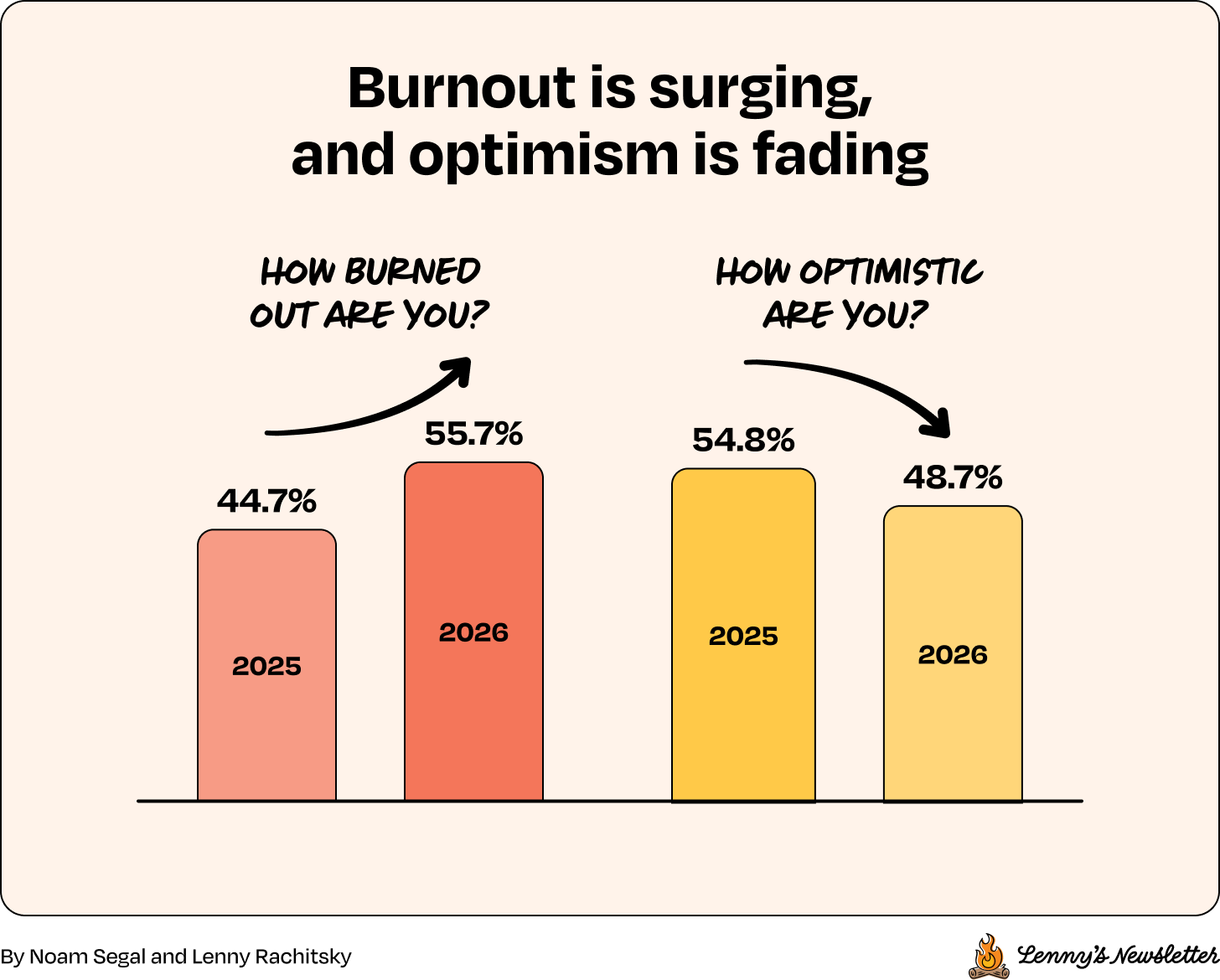
Significant burnout rose from 44.7% to 55.7% in a single year.
倦怠一年从 44.7% 涨到 55.7%
Career optimism fell from 54.8% to 48.7% over the same period.
倦怠激增、乐观消退同时发生;四成人担心丢工作。
-
More than half (53%) would steer a newcomer away from their own role.
53% 会劝新人别入这行
Even people optimistic about their own careers won't recommend the path.
对自己前途乐观,却不愿让朋友重走同一条路——这是最刺眼的矛盾。
-
82% say AI is making them measurably more productive.
82% 说 AI 让自己明显更高效
But many worry the gains come at the cost of the craft.
效率是真的,可很多人担心手艺、深度和质量正在被悄悄掏空。
-
Only 22% worry about “losing my job to AI.”
只有 22% 怕被 AI 抢走饭碗
Far more (51%) fear being expected to do more for the same pay.
真正的恐惧不是失业,而是「同样的钱,干更多的活」。
-
77% picked at least one positive and one negative emotion about AI.
77% 对 AI 又爱又怕
The average person selected more than five emotions.
几乎没人是纯粹乐观或纯粹悲观——矛盾是这一年的底色。
-
Designers and researchers report the most AI anxiety and job-loss fear.
设计师和研究员最焦虑
They also rate their managers worst and are least willing to recommend the field.
AI 焦虑、裁员恐惧、差评经理、最不愿推荐——四项都踩中。
-
Founders are still the happiest people in tech; small companies the best places to work.
创始人最幸福,小公司最好待
Both findings replicate from 2025 and are statistically robust.
在剧烈动荡的一年里还能原样复现,反而更说明它们靠谱。
-
Manager quality remains the strongest lever for happiness.
经理,依然是幸福感的最大杠杆
It's the strongest driver of burnout and one of the strongest of everything else.
AI 再怎么变,你的直属经理好不好,仍是决定你状态的头号变量。
Our biggest takeaways
A year ago, we ran our first large-scale survey of how tech workers feel about their jobs and careers. We summed up what emerged in four words: burned out, but optimistic. Today we’re back with the results from our 2026 survey, and it’s a tale of two workforces.
一年前,我们做了第一次大规模调查,了解科技从业者对自己工作和职业的真实感受。当时我们用四个字总结了浮现出来的状态:倦怠,但乐观。今天我们带着 2026 年调查的结果回来了,而这一次,呈现出的是两支截然不同的劳动力大军。
One half feels amplified by AI—more capable, more confident, more excited than they’ve been in their entire career. The other half feels shaken by it—less sure of their value and whether there’s still a place for them. Which side of that line people fall on predicts how they feel about their career more than anything else, including their current role, seniority, company size, or any other measure we collected. The workforce is bifurcating into two realities.
一半人感觉被 AI 放大了——比职业生涯中任何时候都更有能力、更自信、更兴奋。另一半人则被它动摇了——不再确定自己的价值,也不确定还有没有自己的一席之地。一个人落在这条分界线的哪一侧,比任何其他因素都更能预测他对自己职业的感受,包括当前岗位、资历、公司规模,以及我们采集的任何其他指标。整个劳动力群体正在分裂成两种现实。
But there’s more: Burnout overall jumped 11 points in a single year, and four in 10 respondents are worried about losing their job. Even those who feel optimistic about their own career may not recommend that friends follow their path. In the AI era, everyone agrees the ground is moving. No one is sure yet if it’s an earthquake or a launch.
但还不止于此:整体倦怠水平一年内跳升了 11 个百分点,每 10 位受访者中就有 4 位担心失去工作。即便是那些对自己前途乐观的人,也未必会建议朋友走上和自己相同的路。在 AI 时代,所有人都认同脚下的地面正在移动。只是还没人确定,这究竟是一场地震,还是一次腾飞。
We think these findings are important enough that we’re making this post free for everyone.
我们认为这些发现足够重要,因此决定把这篇文章向所有人免费开放。
Let’s break it down.
我们来逐一拆解。
· The workforce is splitting in two. Tech workers are either amplified by AI or shaken by it, and that divide shapes their feelings about work more than any title, tenure, or company.
· 劳动力群体正在一分为二。科技从业者要么被 AI 放大,要么被它动摇,而这条分界线对他们工作感受的塑造,超过了任何职称、工龄或公司因素。
· Burnout is surging, and optimism is fading. Significant burnout rose from 44.7% to 55.7% of respondents, while career optimism fell from 54.8% to 48.7%. Those who feel destabilized by AI are feeling the least optimistic and the most burned out. A worrisome trend.
· 倦怠在激增,乐观在褪色。报告有明显倦怠的受访者从 44.7% 升到了 55.7%,而职业乐观度则从 54.8% 降到了 48.7%。那些感觉被 AI 动摇的人,乐观度最低、倦怠感最重。这是一个令人担忧的趋势。
· Tech workers wouldn’t recommend their own field. More than half (53%) would steer a newcomer away from a career in their role, even though they’re optimistic about their own future.
· 科技从业者不会推荐自己所在的领域。超过一半(53%)的人会劝新人远离自己这个岗位的职业道路,尽管他们对自己的前途保持乐观。
· Productivity is up, but quality is questionable. 82% say AI is making them measurably more productive, but many worry the gains are coming at the cost of the sharpness of the work and the worker.
· 生产力上升,但质量存疑。82% 的人表示 AI 让他们的生产力有了可衡量的提升,但许多人担心,这些收益是以工作本身和从业者的锐度为代价换来的。
· The underlying fear is of being overworked. Only 22% worry about “losing my job to AI.” Far more worry about being expected to do more for the same pay (51%), getting trapped in an unsustainable pace (46%), and the quality of their work going down (41%).
· 深层的恐惧是被过度使用。只有 22% 的人担心"把工作输给 AI"。远比这更多的人担心的是:被要求拿同样的薪水做更多的活(51%)、陷入难以为继的工作节奏(46%),以及工作质量下降(41%)。
· Almost everyone is ambivalent. 77% of respondents picked at least one positive and one negative emotion about AI. The average person selected more than five emotions. The defining feeling about AI is ambivalence.
· 几乎每个人都心态矛盾。77% 的受访者至少同时选了一种正面和一种负面情绪来描述对 AI 的感受。平均每人选了五种以上的情绪。对 AI 最具代表性的感受,就是矛盾。
· Designers and researchers are the most worried. They report the most AI anxiety, the most fear of job loss, the worst-rated managers, and the lowest willingness to recommend their field. It’s a continuation of a trend we flagged last year.
· 设计师和研究员最忧虑。他们报告的 AI 焦虑最重、失业恐惧最强、对经理的评价最差,推荐自己所在领域的意愿也最低。这延续了我们去年就已指出的趋势。
· Founders are still the happiest people in tech, and small companies are still the best places to work. Both findings replicate from 2025, and both are statistically robust.
· 创始人依然是科技圈里最快乐的人,小公司依然是最好的去处。这两项发现都复现了 2025 年的结论,而且都在统计上相当稳健。
· Managers are still the biggest lever for happiness. Manager quality remains the strongest driver of burnout and one of the strongest drivers of everything else.
· 经理仍然是撬动幸福感的最大杠杆。经理的质量依然是倦怠最强的驱动因素,也是几乎其他所有指标最强的驱动因素之一。
· The industry, in tech workers’ own words, is “chaotic.” Asked to describe the state of tech in a sentence, the most common theme by far was chaos, though the sentiment was split almost evenly between excitement and dread.
· 用科技从业者自己的话说,这个行业"一片混乱"。当被要求用一句话描述科技行业的现状时,遥遥领先、最常出现的主题就是混乱——尽管其中的情绪在兴奋和恐惧之间几乎对半开。
Takeaway 1: The workforce is splitting in two
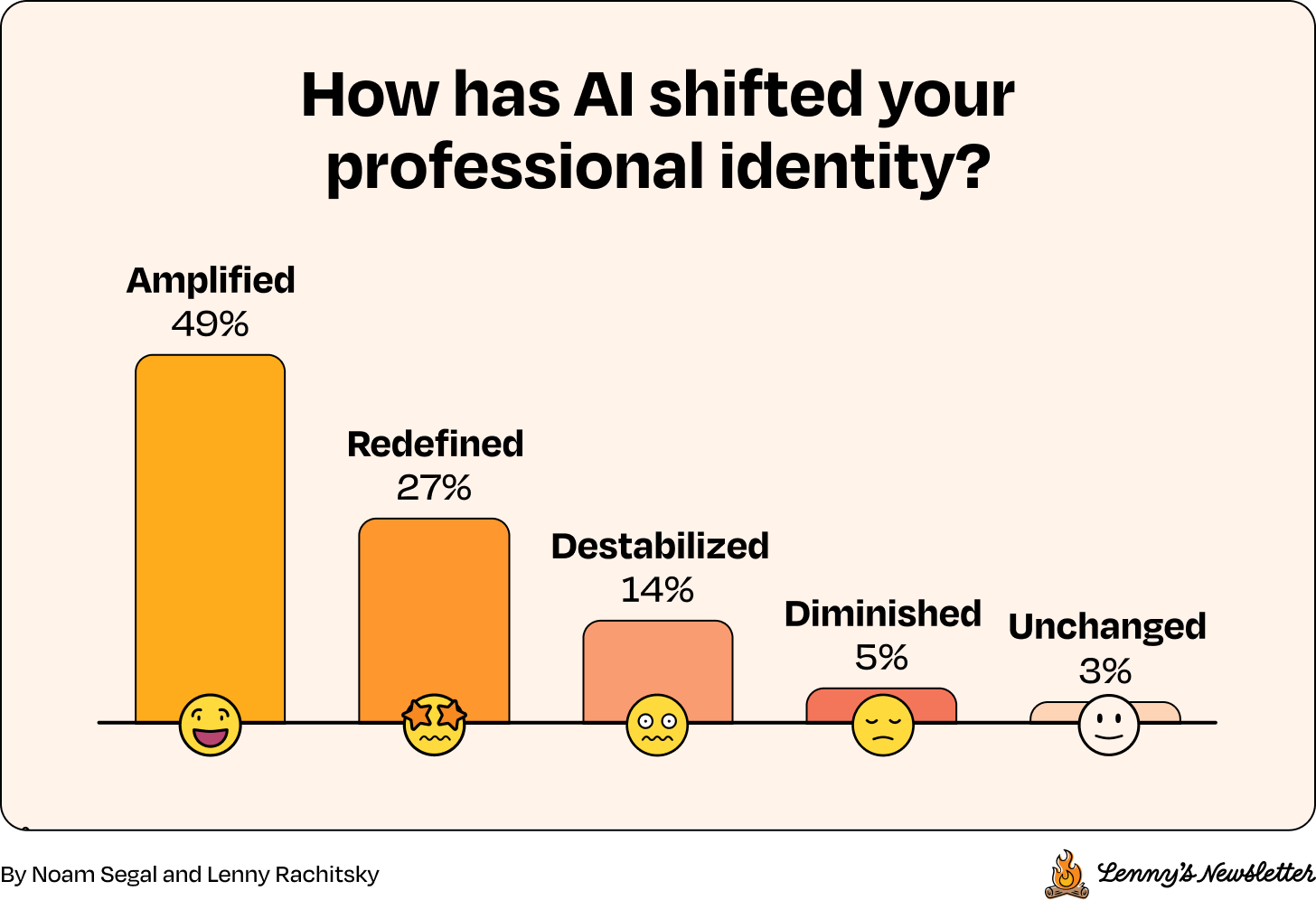
To understand AI’s deeper impact on people, we asked an existential question: How has working with AI shifted how you see yourself as a professional? We gave respondents five options. Here’s how they responded:
为了理解 AI 对人更深层的影响,我们问了一个关乎存在感的问题:与 AI 协作后,你看待自己这名专业人士的方式发生了怎样的变化?我们给出了五个选项。以下是受访者的回答:
· “Amplified (I can do more, and better)”: 49.0%
· "被放大了(我能做更多,也做得更好)":49.0%
· “Redefined (My role is changing shape, but I don’t see that as clearly positive or negative)”: 27.4%
· "被重新定义了(我的角色正在改变形态,但我不觉得这明显是好事或坏事)":27.4%
· “Destabilized (I’m less sure where I stand or what’s really mine)”: 13.9%
· "被动摇了(我不太确定自己的位置,也不确定什么才真正属于我)":13.9%
· “Diminished (I feel less essential or less valuable)”: 5.0%
· "被削弱了(我感觉自己不那么不可或缺、不那么有价值了)":5.0%
· “Unchanged”: 3.2%
· "没有变化":3.2%
When we lined up that question against the rest of the survey, the four identity groups differed dramatically:
当我们把这个问题和调查的其余部分对齐来看时,这四个身份认同群体呈现出巨大的差异:
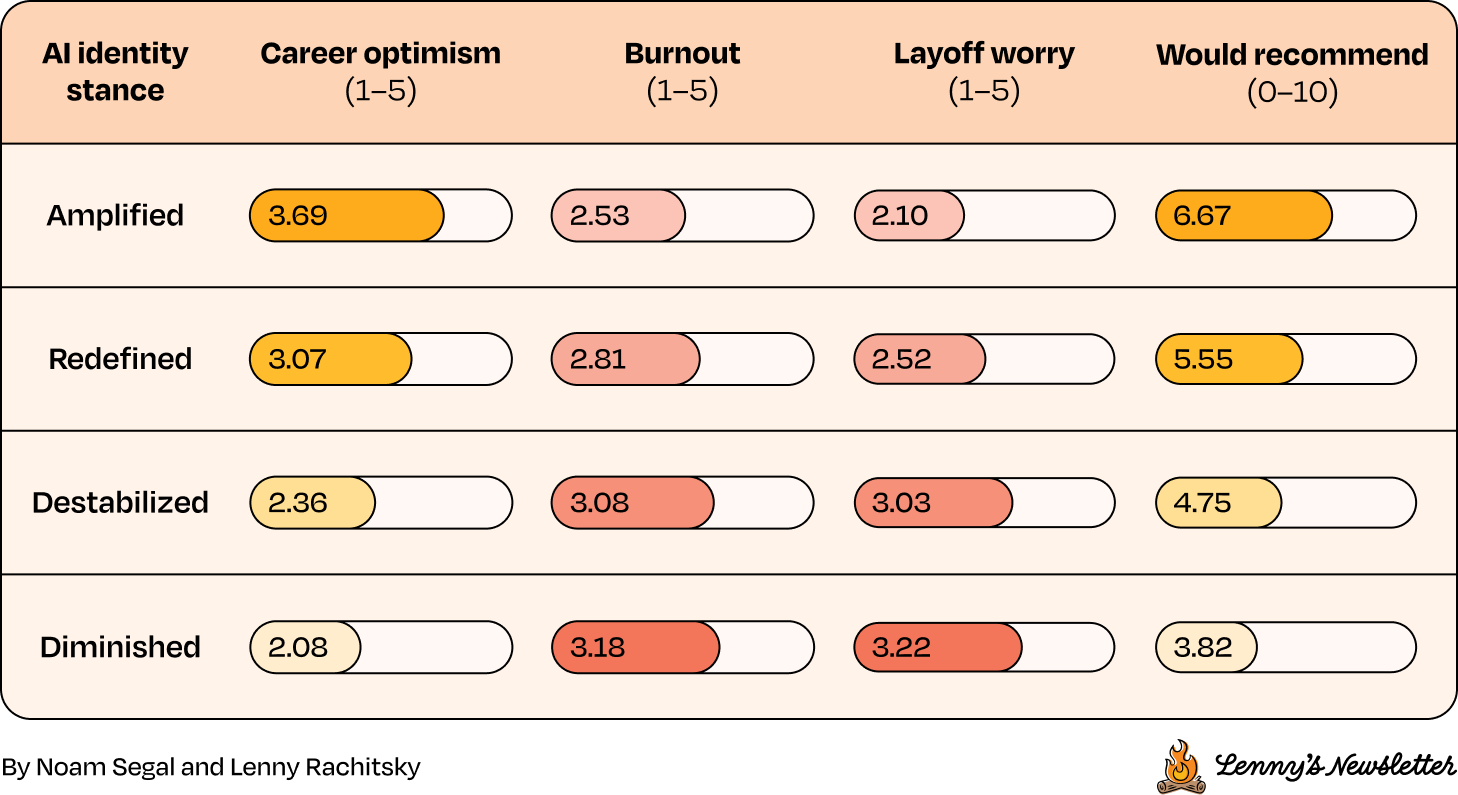
As you go from “amplified” to “diminished,” optimism collapses, burnout climbs, layoff fear climbs, and willingness to recommend the field falls off. The people who feel amplified by AI are thriving. Those who feel diminished by it are in distress on every measure.
从"被放大"一路走到"被削弱",乐观度崩塌,倦怠攀升,裁员恐惧攀升,推荐本领域的意愿则一路走低。那些感觉被 AI 放大的人正在蓬勃向上,而那些感觉被它削弱的人,在每一项指标上都陷入了困境。
To make sure this wasn’t an artifact, we ran the numbers a few different ways:
为了确认这不是数据假象,我们用几种不同的方法重新跑了一遍:
· In a regression pitting every variable against each other, AI-identity stance was the single strongest predictor of career optimism (standardized β = +0.39) and of whether someone would recommend their field (β = +0.60)—stronger than role, level, and company size combined.
· 在一个把所有变量放在一起相互较量的回归模型中,对 AI 的身份认同立场是职业乐观度(标准化 β = +0.39)以及是否会推荐本领域(β = +0.60)最强的单一预测因子——比岗位、级别和公司规模加起来还要强。
· As an effect size, the gap between the “amplified” and “diminished” groups on optimism is large (Cohen’s d ≈ 1.55). For context, the famously strong “founder effect” we’ll discuss later clocks in at d ≈ 0.56. The AI divide is roughly three times as large as that. It is, by a wide margin, the biggest effect in the dataset.
· 作为效应量,"被放大"和"被削弱"两个群体在乐观度上的差距非常大(Cohen's d ≈ 1.55)。作为参照,我们后面会讨论的那个出了名强的"创始人效应",其效应量为 d ≈ 0.56。AI 分歧大约是它的三倍,遥遥领先,是整个数据集中最大的效应。
The question that best predicts how a tech worker feels about their work, in 2026, is no longer “What do you do?” or “Where do you work?” It’s “What has AI done to your sense of who you are?”
在 2026 年,最能预测一名科技从业者对工作感受的问题,已经不再是"你做什么工作?"或"你在哪儿工作?",而是"AI 对你关于'我是谁'的认知,做了什么?"
Meet the four tech workers of 2026
认识 2026 年的四类科技从业者
We did one more pass on this data: instead of using a single identity question, we clustered respondents based on the full pattern of emotions they reported about AI. Four types emerged, and you almost certainly recognize them.
我们对这份数据又做了一轮处理:不再依赖单一的身份认同问题,而是根据受访者报告的对 AI 的完整情绪模式做聚类。结果浮现出四种类型,你几乎一定能认出他们。
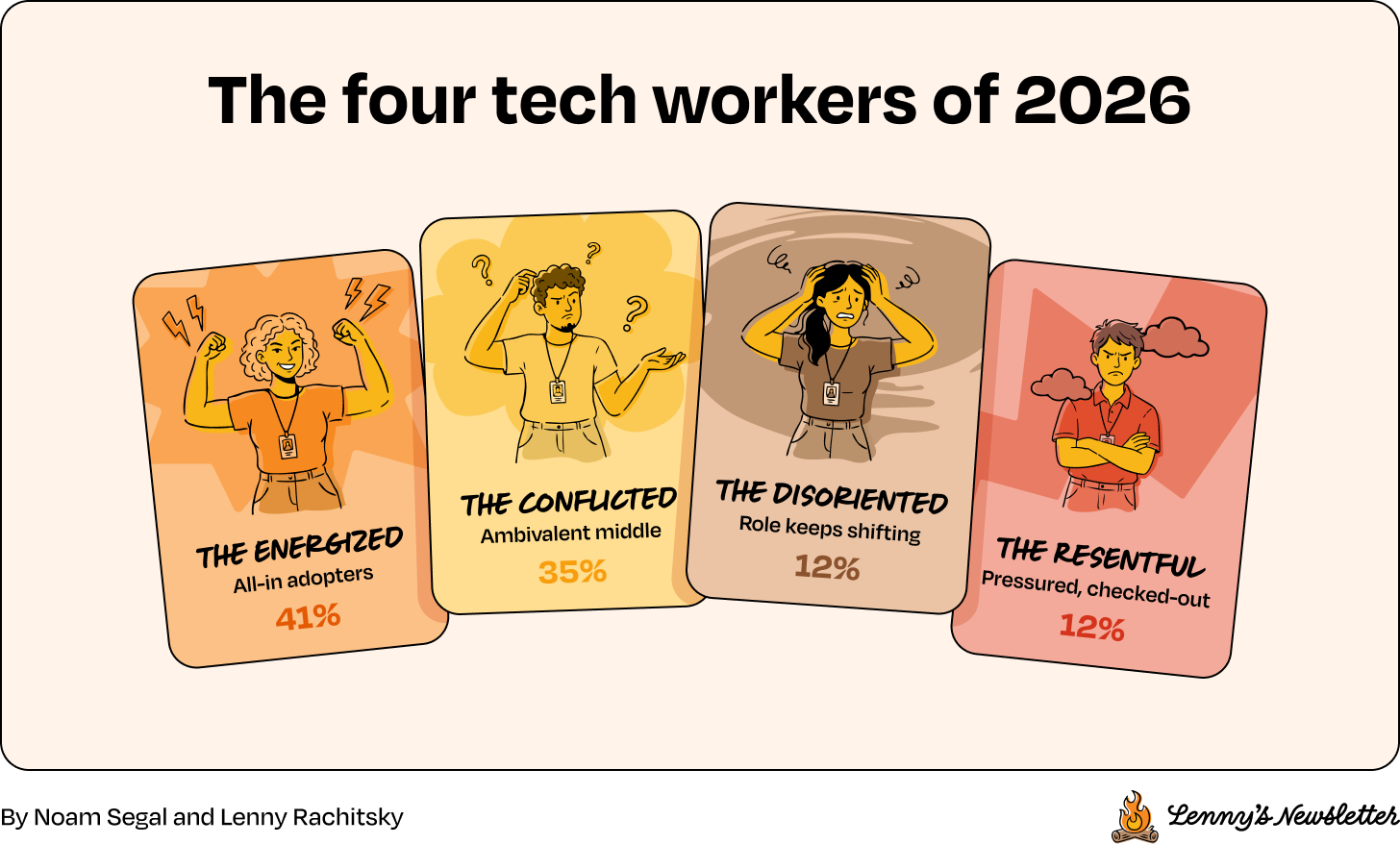
The Energized (41%). The all-in adopters. They lead with “excited” (91%), “curious” (83%), and “hopeful” (59%). They’re the most optimistic group, the least burned out, and the only segment with a clearly positive read on their field. For them, AI truly seems like a superpower.
充满能量者(41%)。全力投入的采用者。他们最突出的情绪是"兴奋"(91%)、"好奇"(83%)和"充满希望"(59%)。他们是最乐观的群体,倦怠感最低,也是唯一一个对自己所在领域明显持正面看法的细分群体。对他们来说,AI 真的像是一种超能力。
“Product has become fun again! You become an explorer, you play around . . . you spend long hours full of excitement. We’re in an amusement park.” —PM, Principal IC
The Conflicted (35%). The ambivalent center of gravity—and the largest group after the Amplified. Their signature emotions are “conflicted—holding positive and negative feelings at once” (68%)—and “curious” (64%), trailed closely by “overwhelmed” (56%) and “tired” (55%). They haven’t soured on AI; they’re just exhausted by the work of keeping up with it while holding two feelings at the same time.
心态矛盾者(35%)。矛盾情绪的重心所在——也是仅次于"充满能量者"的第二大群体。他们标志性的情绪是"矛盾——同时抱有正面和负面感受"(68%)和"好奇"(64%),紧随其后的是"不堪重负"(56%)和"疲惫"(55%)。他们并没有对 AI 心生厌恶;他们只是被同时抱着两种感受、又要努力跟上 AI 的那份辛劳给累垮了。
“I’m simultaneously having the most fun I’ve had as a product builder and also feeling the most uncertainty I’ve felt. I’m confident I’ll be able to keep my skills sharp and adapt, but I’m not yet sure what it is that I’ll need to adapt into.” —PM, Senior IC
The Disoriented (12%). Defined almost entirely by one feeling: “disoriented—my role keeps shifting,” layered with “overwhelmed” (74%) and “tired” (73%). These are people watching their job change shape beneath them faster than they can find their footing again. They still think AI is somewhat useful. They’re not “refusers.” They’re just losing the thread of their role in the workplace.
迷失方向者(12%)。几乎完全由一种感受定义:"迷失方向——我的角色一直在变",再叠加上"不堪重负"(74%)和"疲惫"(73%)。这些人眼睁睁看着自己的工作在脚下不断变形,变化的速度快过他们重新站稳脚跟的速度。他们仍然认为 AI 多少有些用处。他们不是"拒绝者"。他们只是渐渐抓不住自己在职场中角色的那条线索了。
“Things are so uncertain, we’re like farmers on the cusp of the industrial revolution. We know going into farming is the wisest long-term career choice, but we don’t see a clear path. This kind of uncertainty crowds out productivity.” —VP Product
The Resentful (12%). The burned-out and checked-out. Every one of them selected “resentful—I feel pressured to use AI,” and they cluster with “tired,” “conflicted,” and “overwhelmed.” They report the lowest optimism, the lowest willingness to recommend their field, and the lowest sense that AI is helping them at all. This is AI fatigue transformed into resistance.
心怀怨怼者(12%)。倦怠且已抽离的一群人。他们每一个人都选了"怨怼——我感到被迫使用 AI",并且和"疲惫""矛盾""不堪重负"聚在一起。他们报告的乐观度最低,推荐本领域的意愿最低,认为 AI 对自己有任何帮助的感受也最低。这是 AI 疲劳演变成了抵触。
“Tech overall kind of sucks right now. We used to adopt new technology because we were excited about the cool new things we could do. Now all we hear is ‘Use AI or you will lose your job’—and then people get fired anyway. I hate it.” —Director of Product
Takeaway 2: Burnout is surging, and optimism is fading
Significant burnout is now the majority experience for tech workers. 55.7% of working tech professionals report significant burnout—meaning they describe themselves as “moderately,” “very,” or “completely” burned out. Last year, that number was 44.7%. More than a quarter (26.2%) are now “very” or “completely” burned out.
如今,严重的职业倦怠已经成为科技从业者的普遍体验。55.7% 的在职科技专业人士报告存在严重倦怠——也就是形容自己“中度”“非常”或“完全”倦怠。去年,这个数字还是 44.7%。超过四分之一(26.2%)的人如今已处于“非常”或“完全”倦怠的状态。
Career optimism is dropping. Fewer than half (48.7%) of respondents are optimistic about the future of their career (down from 54.8% being optimistic last year). We’ve gone from “burned out but optimistic” in 2025 to “significantly burned out, and not that optimistic” a year later. We’re curious (and a little scared) about how this will look in a year.
对职业前景的乐观情绪正在下滑。只有不到一半(48.7%)的受访者对自己的职业未来抱有乐观态度(去年这一比例为 54.8%)。我们从 2025 年的“倦怠但乐观”,变成了一年后的“严重倦怠,且没那么乐观”。再过一年会是什么样,我们既好奇又有点害怕。
That being said, job enjoyment is holding up: 42.6% enjoy their work “very much” or “extremely”; another 36.7% rate it “moderately”; and only about one in five (20.6%) enjoy it slightly or not at all.
话虽如此,对工作本身的喜爱程度仍然坚挺:42.6% 的人“非常”或“极其”享受自己的工作;另有 36.7% 给出“中等”评价;只有约五分之一(20.6%)的人只是略微喜欢或根本不喜欢。
Why the apparent contradiction? Enjoyment, burnout, and optimism are different constructs. Enjoyment is about the work itself, and people still like the work. Burnout is about pace, and people are increasingly worn out by how much they have to do. Optimism is about where things are heading. You can love your craft, be worn out by how much of it you’re doing, and feel doubt about the future all at once.
为什么会出现这种表面上的矛盾?因为喜爱、倦怠和乐观是三种不同的东西。喜爱针对的是工作本身,人们依然喜欢自己做的事。倦怠针对的是节奏,人们越来越被繁重的工作量拖垮。乐观针对的是趋势走向。你完全可能同时:热爱自己的手艺、被过大的工作量榨干、又对未来心存疑虑。
How worried are you about layoffs?
你有多担心被裁员?
This year, we also added a question to the survey: How worried are you about being laid off in the next year?
今年,我们还在调查中新增了一个问题:未来一年,你有多担心自己被裁员?
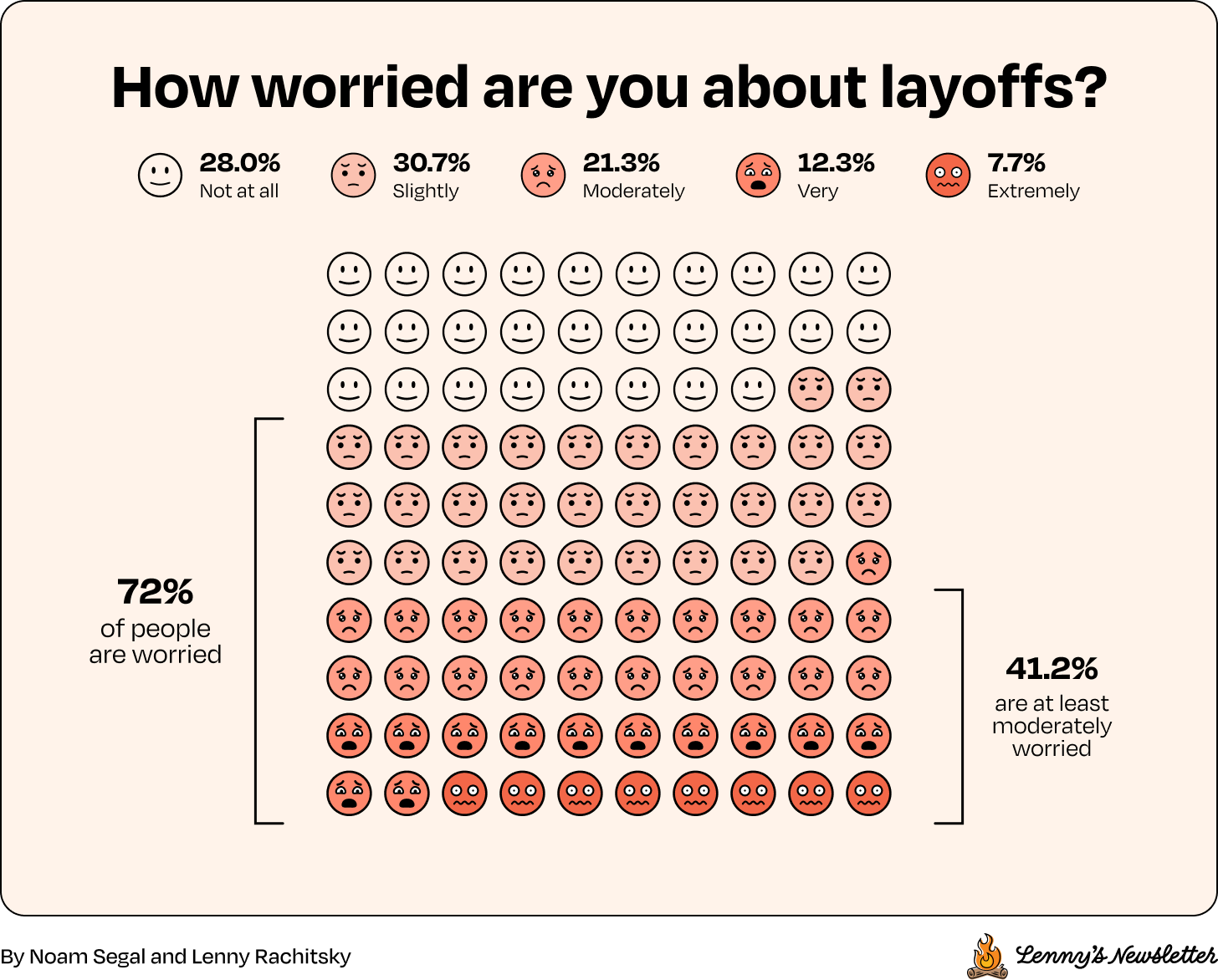
41.2% are at least moderately worried, including 19.9% who are “very” or “extremely” worried. 28% aren’t worried at all. So roughly four in 10 tech workers are carrying real job-security anxiety into their week—a sizable undercurrent.
41.2% 的人至少中度担心,其中 19.9% 表示“非常”或“极其”担心。28% 的人完全不担心。也就是说,大约每 10 名科技从业者中,就有 4 人带着实实在在的职业安全感焦虑度过每一周——这是一股不小的暗流。
What makes layoff worry worth its own question is how tightly it’s bound to everything else. Of all the things we measured, layoff worry is the single strongest correlate of career pessimism (r = –0.47). Nothing else tracks negative outlook as closely. When people are scared of losing their jobs, their optimism goes first.
裁员担忧之所以值得单独设一个问题,是因为它与其他一切都紧密相连。在我们衡量的所有因素中,裁员担忧是与职业悲观情绪相关性最强的单一因素(r = –0.47)。没有任何其他因素能如此紧密地对应负面预期。当人们害怕丢掉工作时,最先崩塌的就是乐观情绪。
We’ll come back to who is most worried later. It’s not who you might guess.
至于谁最担心,我们稍后会回来讲。答案可能出乎你的意料。
Takeaway 3: Tech workers wouldn’t recommend their own field
This year, we asked an NPS-like question about people’s careers and roles: On a scale of 0 to 10, how likely are you to recommend a career in your role to a friend starting out today?
今年,我们就人们的职业和岗位问了一个类似 NPS 的问题:用 0 到 10 分打分,你有多大可能向一个今天刚入行的朋友推荐从事你这个岗位的职业?
More than half of working tech professionals would actively steer a newcomer away from the path they chose. That translates to an average NPS score of –39. Moreover, a third of the people who call themselves optimistic still wouldn’t recommend their own field.
超过半数的在职科技专业人士会主动劝阻新人别走自己当初选择的这条路。换算下来,平均 NPS 得分为 –39。而且,在那些自称乐观的人当中,仍有三分之一不会推荐自己所在的行业。
The cleanest way to say it: “The water’s fine; don’t come in.” People have largely made peace with their own trajectory. They’ve got the skills, the relationships, and the seniority to ride it out. But they’ve lost faith that the on-ramp still works for someone behind them.
最直白的说法是:“水挺好的;但别下来。”人们大体上已经跟自己的职业轨迹和解了。他们有技能、有人脉、有资历,足以扛过去。但他们已经不再相信这条入行的通道对后来者还管用。
“I’m lucky I’m later in my career . . . AI can augment what I’ve built. I think I won’t be in a position to hire and mentor new PMs, but I’ll be safe. Which feels really crappy to say.”
“I’m at the point where I can just retire and choose not to, so I’m not worried about my own career. But I’m worried about the younger generations.”
The recommendation score varies enormously by role, and the spread is its own story.
这个推荐得分因岗位不同而差异巨大,而这种差距本身就是一个值得讲的故事。
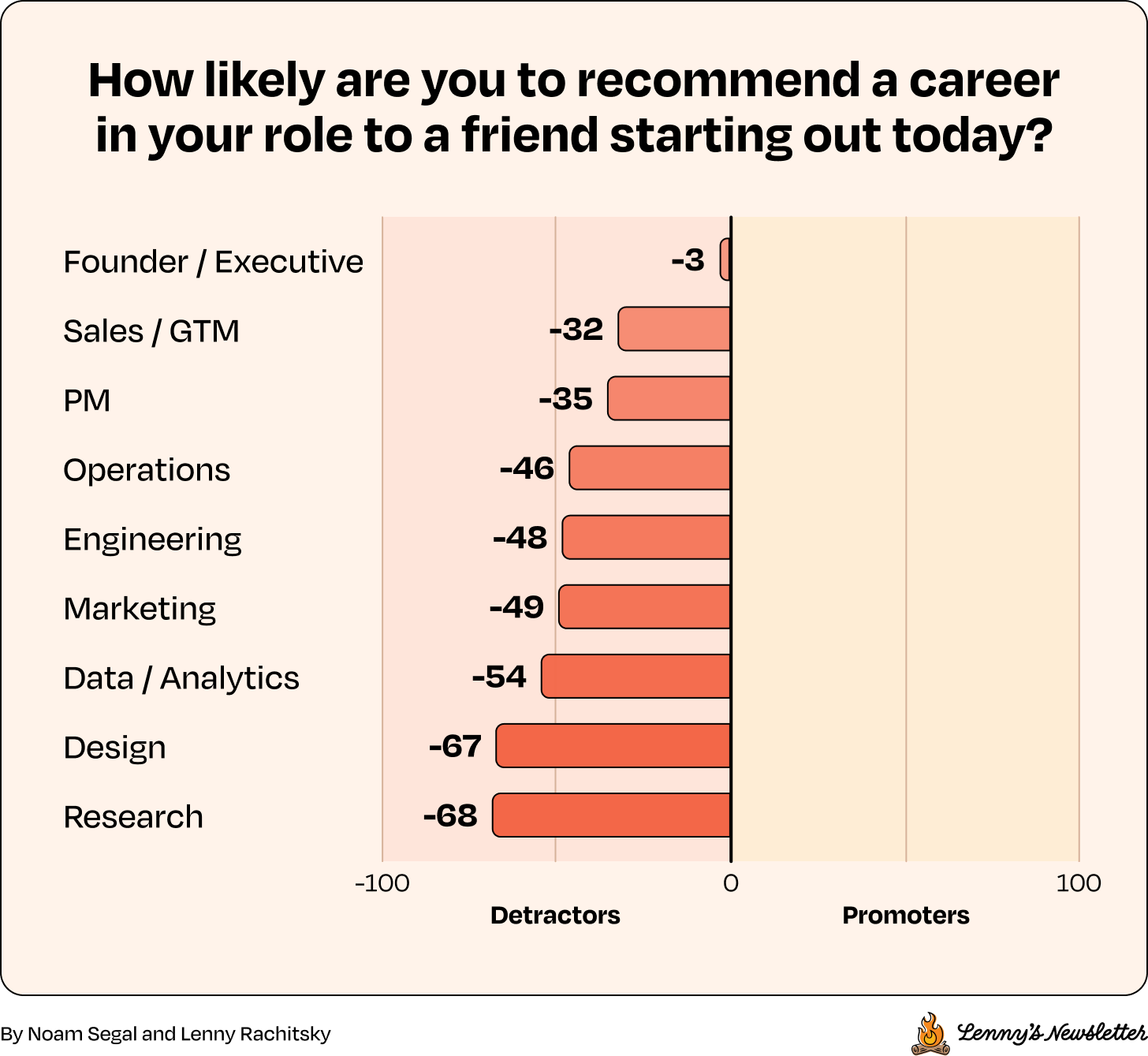
Founders would (just barely) still wave you in. Designers and researchers very much would not. And the score climbs steadily with seniority: senior and staff-level individual contributors are the least likely to recommend their field (both at NPS –49), while VPs (–23) and founders (–5) are the most. The further up you’ve climbed, the more the ladder still looks worth it; the people on the rungs below are the ones telling others not to start the climb.
创始人(勉强)还是会招手让你进来。设计师和研究员则非常不会。而且这个得分随资历稳步攀升:高级和资深级别的独立贡献者(IC)最不愿意推荐自己的行业(两者 NPS 均为 –49),而 VP(–23)和创始人(–5)最愿意。你爬得越高,这架梯子就越显得值得往上爬;而站在下面几级台阶上的人,才是那些劝别人别开始往上爬的人。
Takeaway 4: Productivity is up, but quality is questionable
Given the rising burnout, the layoff anxiety, the doom in the discourse, you’d expect tech workers to be rather sour on AI. They’re not.
考虑到不断攀升的职业倦怠、裁员焦虑,以及舆论场里弥漫的末日感,你或许会以为科技从业者对 AI 相当反感。事实并非如此。
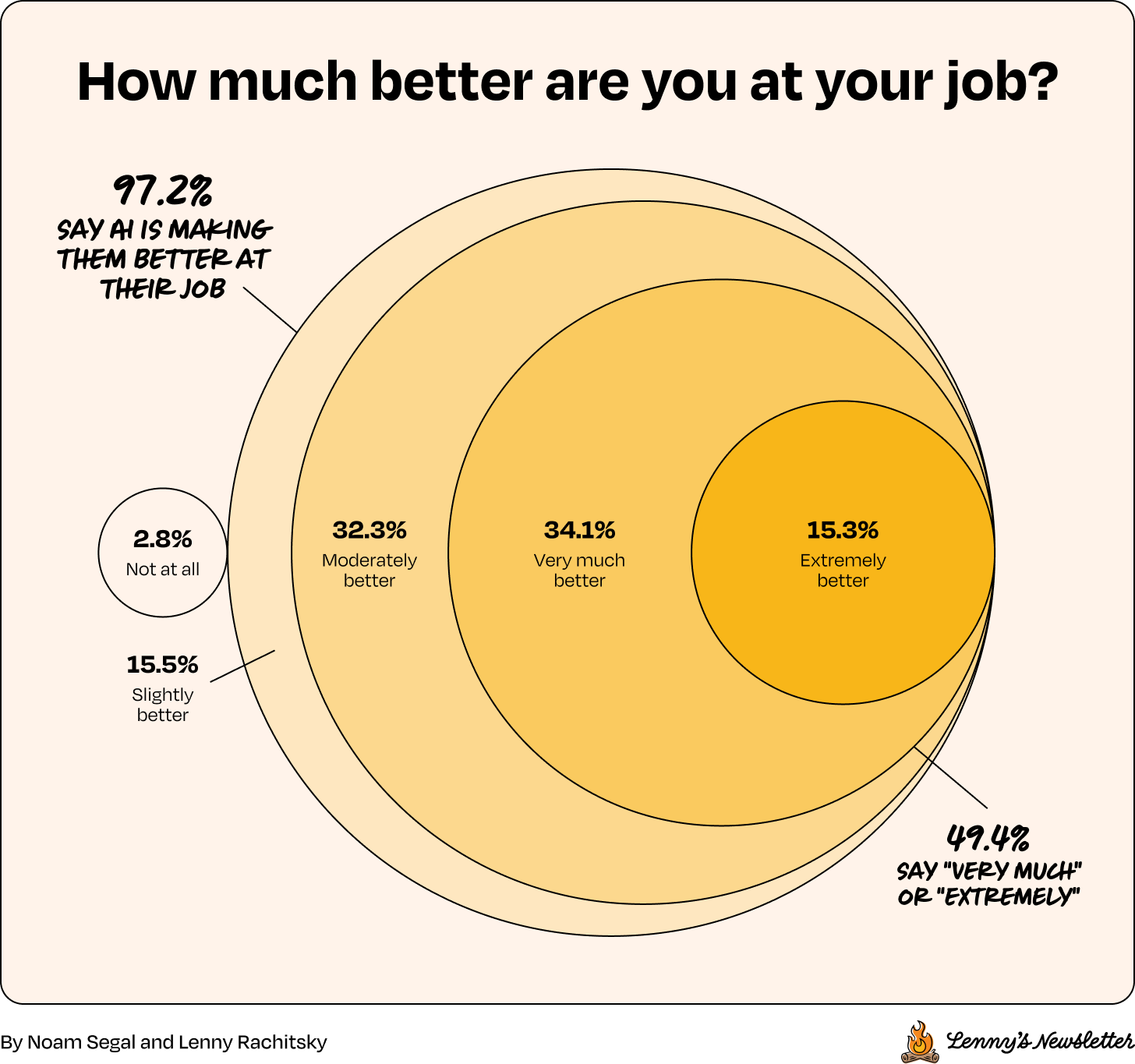
At the individual level, the AI numbers are among the most positive in the survey. 82% say AI is already making them at least moderately better at their job, and nearly half (49.4%) say “very much” or “extremely.” 60% feel confident or ahead of their peers in AI skills, compared with just 22.5% who feel anxious or behind.
在个人层面,AI 相关的数字是整份调查中最正面的一批。82% 的人表示 AI 已经让自己在工作上至少变得中等程度地更强,近一半(49.4%)的人表示提升“非常大”或“极大”。60% 的人对自己的 AI 技能感到自信,或觉得领先于同侪,而只有 22.5% 的人感到焦虑或落后。
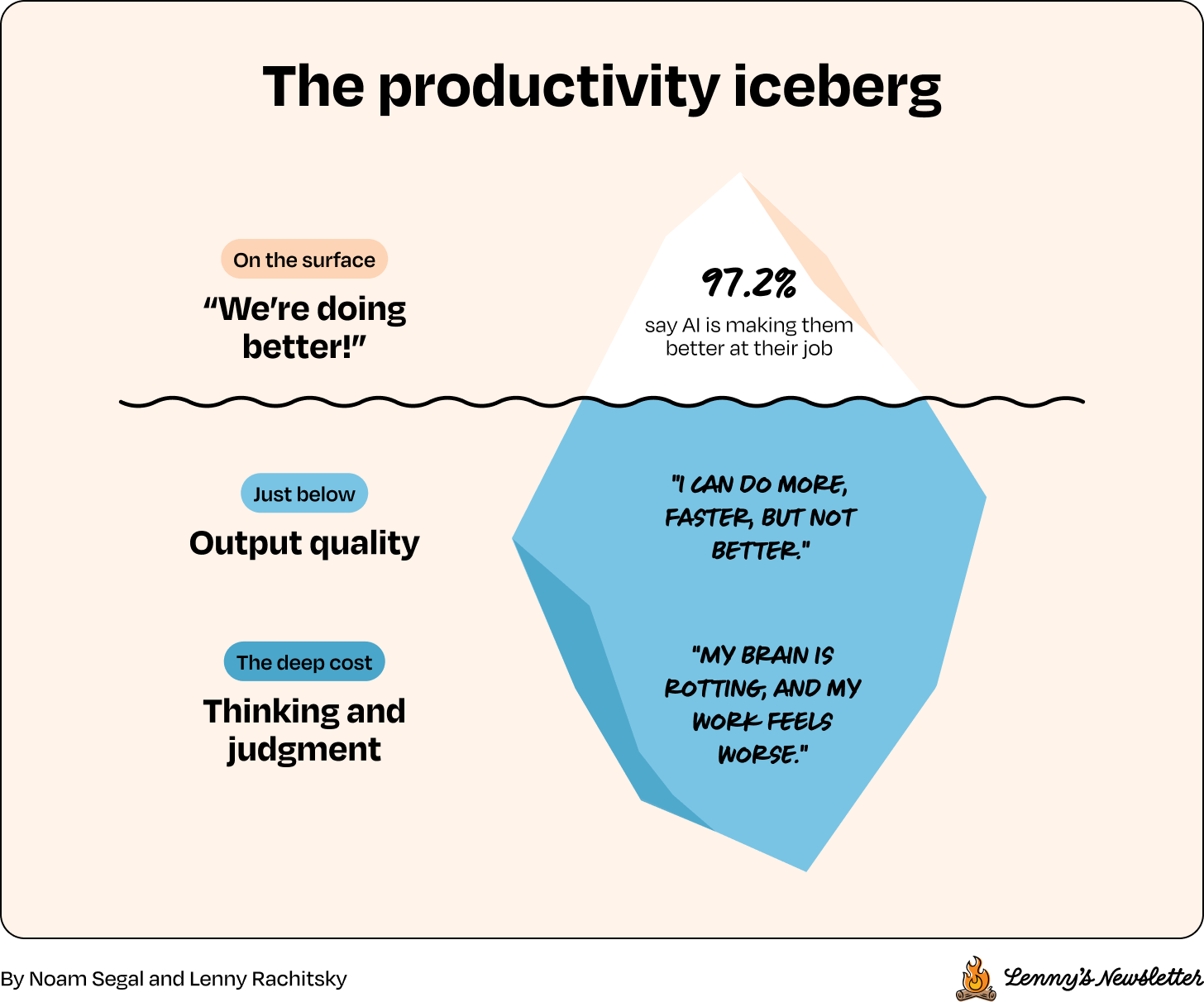
But then we looked closer at what “better at my job” means. When we asked people to describe in their own words how AI had changed their work, “better” turned out to mean producing more and faster, but not higher quality. The productivity gains are coupled with deep unease about the costs of leveraging AI.
但随后我们进一步细看了“在工作上变得更强”究竟意味着什么。当我们请人们用自己的话描述 AI 如何改变了他们的工作时,“更强”原来指的是产出更多、更快,但质量并没有更高。生产力的提升,伴随着对借助 AI 所付出代价的深切不安。
“I can do more, faster, but not better.”
“Amplified and destabilized at the same time. We just set a new denominator for the job. And it moves higher and higher every month.”
And the cost isn’t only in the quality of outputs. A striking number of people described their focus, their judgment, and their thinking as suffering:
而代价还不只体现在产出的质量上。相当多的人形容自己的专注力、判断力和思考能力都在受损:
“I’m amplified, but my brain is rotting, and my work feels worse.”
“I feel like I don’t think hard enough anymore—I just follow Claude. I don’t fully understand what I merge.”
“I miss feeling smart and having aha moments. I miss talking [to] and brainstorming [with] humans instead of machines.”
The productivity gains are real, but the quality of the work and the sharpness of the person producing it are taking a hit. The bar keeps rising to match what AI makes possible, and a growing share of people feel that neither the output nor their own mind is keeping up.
生产力的提升是真实的,但工作的质量、以及产出者本人的思维锐度,都在受损。标准不断被抬高,以匹配 AI 所能实现的上限;而越来越多的人感到,无论是产出还是自己的头脑,都跟不上了。
Takeaway 5: The underlying fear is of being overworked
Respondents’ number-one worry about AI’s impact on their career is the squeeze—AI raised the bar for output, and the reward was . . . more output expected, for the same paycheck.
受访者对 AI 影响职业生涯的头号担忧,是那种被挤压的感觉——AI 抬高了产出的门槛,而回报却是……在同样的工资下,被期待交出更多产出。
They’re scared that the work will get harder, faster, and cheaper, and that they’ll be expected to keep smiling through it.
他们害怕工作会变得更难、更快、更廉价,而自己还得笑着扛下来。
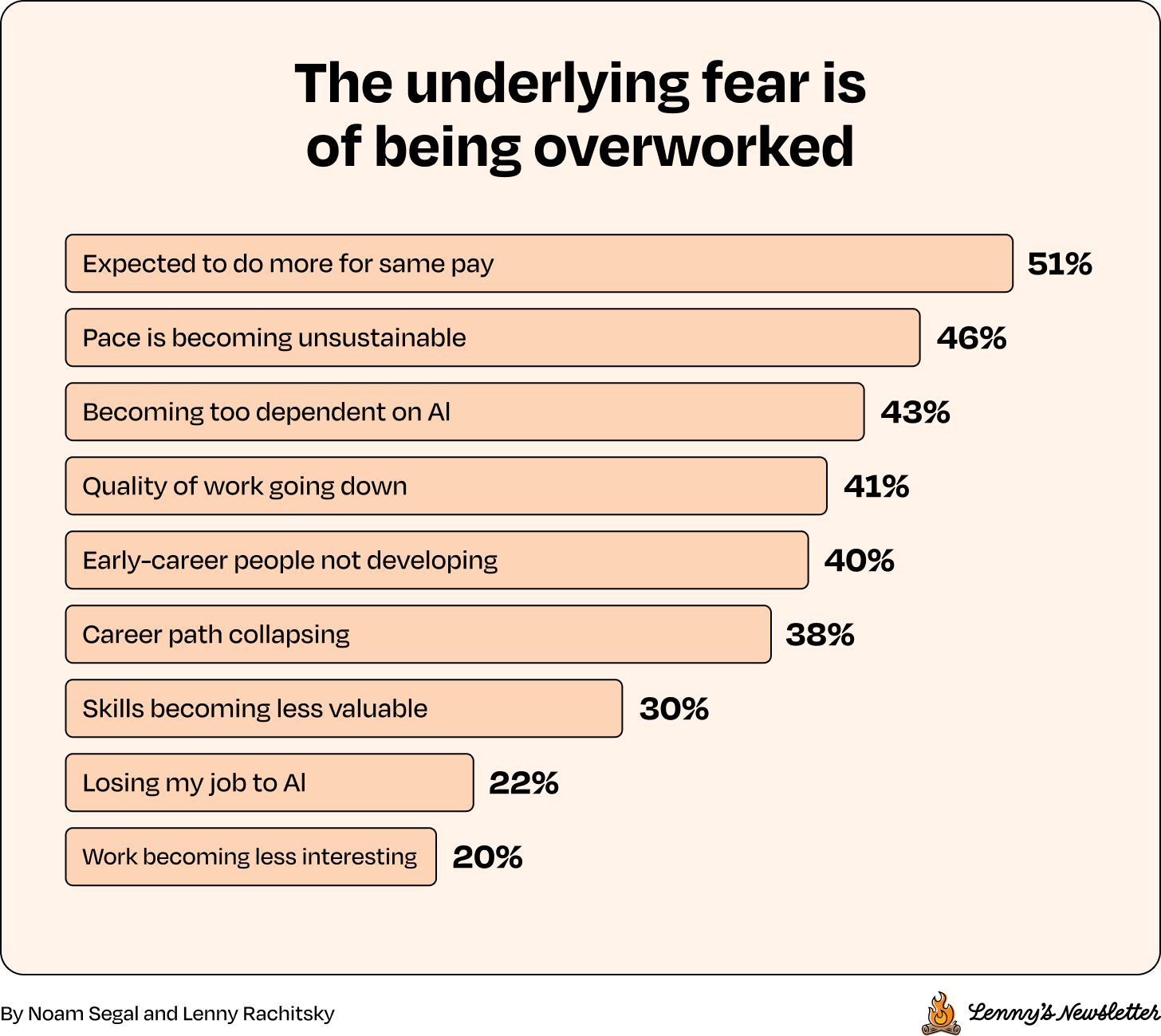
It feels like the dominant narrative about AI and work has been about replacement: the robots are coming for your job. Clearly, that’s not what tech workers are most afraid of. “Losing my job to AI” came in near the bottom of the list, at 22%.
关于 AI 与工作的主流叙事似乎一直围绕着替代:机器人要来抢你的饭碗。但显然,这并不是科技从业者最害怕的事。“工作被 AI 取代”排在榜单接近末尾的位置,只有 22%。
Remember the “AI is replacing parts of my job” question? Half of the respondents say it’s happening to at least a moderate extent. You’d expect that feeling to drive layoff anxiety, but it doesn’t. The correlation between “AI is taking over parts of my job” and “I’m worried about being laid off” is essentially zero (r = +0.05).
还记得那个“AI 正在取代我工作的一部分”的问题吗?半数受访者表示这至少在中等程度上正在发生。你或许会以为这种感受会引发裁员焦虑,但并没有。“AI 正在接管我工作的一部分”与“我担心被裁员”之间的相关性基本为零(r = +0.05)。
What people are actually worried about is being asked to do more for the same pay, and watching the quality of their work slip.
人们真正担心的,是被要求用同样的薪水做更多的事,同时眼睁睁看着自己工作的质量下滑。
It shows up vividly in the open-ended answers:
这在开放式回答中体现得淋漓尽致:
“More and more work is being handed off to me because I can use AI to get it done. But that makes it impossible to keep up with quality standards and not burn out.”
“AI helps with the toil, but then it’s also an enabler to do even more toil.”
“When we automate intellectual tasks, we’ll have to do high-value creative or strategic work only—doing that eight hours a day is not realistic. I used to take rest during repetitive tasks.”
This might sound like it contradicts the layoff worry from earlier. It doesn’t. People fear layoffs, but they mostly don’t blame AI for them. What they fear from AI is being buried in more work.
这听起来或许和前面提到的裁员担忧相矛盾。其实并不矛盾。人们害怕裁员,但大多不把裁员归咎于 AI。他们害怕 AI 带来的,是被更多的工作淹没。
Add this all up, and you get a workforce that’s more productive than ever but quietly dreading what comes next. The speed AI unlocked got plowed straight back into expectations. Every gain becomes the new baseline, and the people expected to hit it are running out of room to breathe.
把这一切加在一起,你得到的是一支比以往任何时候都更高效、却在暗自忧惧未来的劳动力队伍。AI 释放出的速度,被原封不动地转化成了更高的期望。每一次进步都成了新的基准线,而被要求达到这条线的人,已经快没有喘息的余地了。
Takeaway 6: Almost everyone is ambivalent
If there’s one feeling that defines tech workers’ relationship with AI in 2026, it isn’t excitement, and it isn’t fear. It’s both, at the same time.
如果说有一种情绪定义了 2026 年科技从业者与 AI 的关系,那既不是兴奋,也不是恐惧。而是二者同时存在。
We asked people to check off every emotion that described how they feel about AI in their work. Here’s the full list, in order:
我们请大家勾选所有能描述他们对工作中 AI 感受的情绪。以下是完整列表,按选择比例排序:
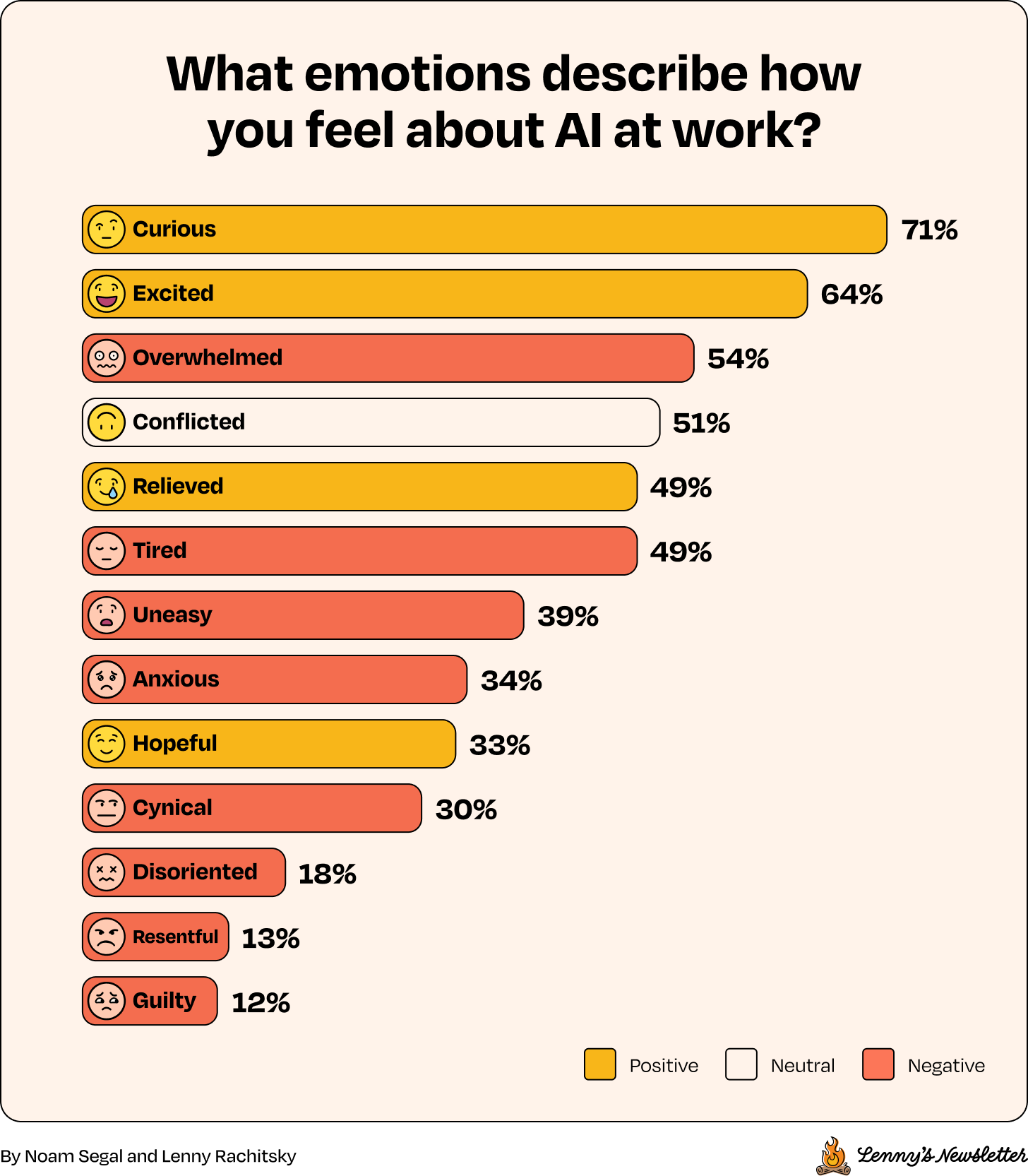
The two leaders are unambiguously positive (curious, excited). But the next cluster (if we ignore “conflicted”) is made up of people who are overwhelmed and tired. People are curious and overwhelmed. Excited and tired. Only 33% feel “hopeful,” even though 64% feel “excited.” Excitement about the present is running well ahead of hope about where this all goes.
排在前两位的情绪毫无疑问是正面的(好奇、兴奋)。但紧随其后的那一簇(如果我们把“矛盾”排除在外),则是那些感到不堪重负和疲惫的人。人们既好奇又不堪重负。既兴奋又疲惫。尽管有 64% 的人感到“兴奋”,却只有 33% 的人感到“充满希望”。对当下的兴奋,远远跑在了对这一切走向的希望之前。
Nikhyl Singhal named this phenomenon “smiling exhaustion.” The burnout of a few years ago was grim—all overhead and no agency. Today’s is different. People are shipping again, compensation has climbed, and many roles seem reborn. The catch is that there’s no off-switch: the tempo is brutal, and the rules rewrite themselves every month. It’s relentless, but it can also be exhilarating.
Nikhyl Singhal 把这种现象称为“微笑式疲惫”。 几年前的那种职业倦怠是灰暗的——全是负担,毫无掌控感。今天的倦怠则不同。人们又开始出活了,薪酬涨了,许多岗位仿佛焕然重生。问题在于,这里没有关闭开关:节奏残酷,而规则每个月都在自我改写。它令人无从喘息,但也可以令人兴奋。
You see this in that 51% explicitly selected “holding positive and negative feelings at once.” But that undercounts the real ambivalence. When we looked at who picked at least one positive and at least one negative emotion, the number jumped to 77%. The average respondent selected five or more emotions (one person selected 13). It’s a workforce in which three out of four individuals are carrying a complex set of emotions about work.
你能从这一点看出端倪:有 51% 的人明确选择了“同时怀有正面和负面情绪”。但这其实低估了真实的矛盾程度。当我们统计那些至少选了一种正面情绪、又至少选了一种负面情绪的人时,这个数字跃升到了 77%。平均每位受访者选择了五种或更多情绪(有一个人选了 13 种)。这是一支四个人里有三个都对工作怀着复杂情绪的劳动力队伍。
Takeaway 7: Designers and researchers are the most worried
If AI is dividing the workforce, the obvious question is: along what lines? Who’s getting amplified, and who’s getting left behind?
如果 AI 正在把劳动力队伍一分为二,那么显而易见的问题是:分界线在哪里?谁被放大了,谁又被甩在了后面?
The clearest pattern is by role: designers and researchers are at the epicenter of AI anxiety across the board, while founders and executives are feeling the best. We measured the share of each role that landed in negative identity or emotional buckets, and the spread is stark:
最清晰的分化模式体现在角色上:设计师和研究员全方位地处在 AI 焦虑的震中,而创始人和高管的感受则最为良好。我们测量了每个角色中落入负面身份认同或情绪区间的人的比例,差距十分悬殊:
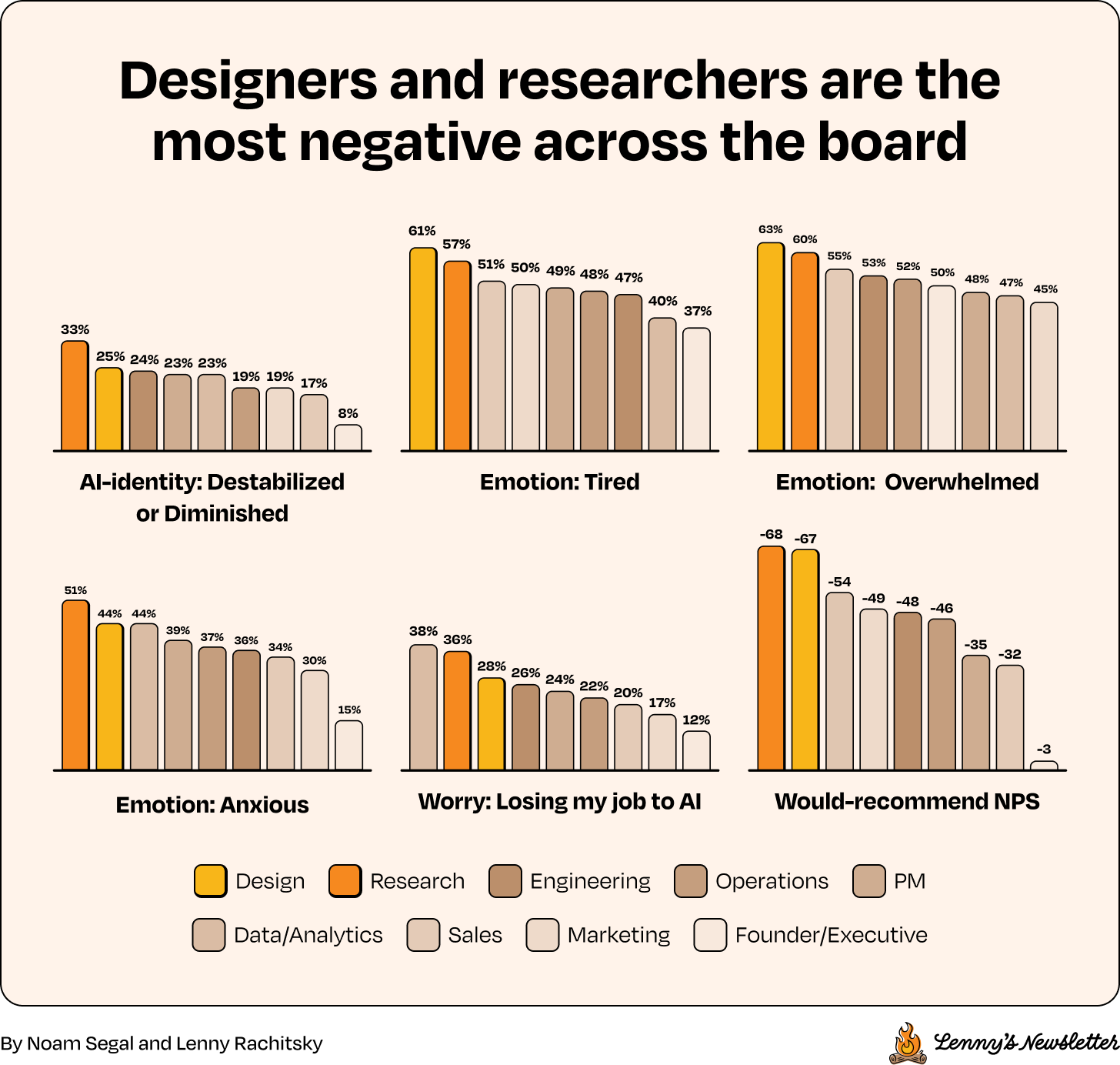
Among researchers, 51% are “anxious about my job security,” versus 15% of founders. Among designers, 63% feel “overwhelmed by the pace of change” and 61% feel “tired,” the highest of any role. Researchers are among the most likely to fear “losing my job to AI” (36%, just behind Data/Analytics at 38%), and designers are the most likely to feel the comp squeeze (61% selected “expected to do more for the same compensation”). Both report the lowest willingness to recommend their field of any role, and designers, as we’ll see, report the worst-rated managers in the survey.
在研究员中,有 51% 的人“对自己的工作稳定性感到焦虑”,而创始人中这一比例仅为 15%。在设计师中,有 63% 的人感到“被变化的速度压得喘不过气”,61% 的人感到“疲惫”,是所有角色中最高的。研究员是最有可能害怕“被 AI 抢走工作”的群体之一(36%,仅次于数据/分析岗的 38%),而设计师则是最能感受到薪酬挤压的群体(61% 的人选择了“被期待用同样的薪酬做更多的事”)。这两类人对自己所在领域的推荐意愿,在所有角色中都是最低的;而且正如我们接下来会看到的,设计师报告的经理评分是整个调查中最差的。
Last year, designers and researchers showed the largest negative sentiment shift of any group. A year later, they’re the most negative on nearly every measure we have.
去年,设计师和研究员是所有群体中负面情绪转变幅度最大的。一年之后,他们在我们掌握的几乎每一项指标上都是最负面的。
As a researcher, I’m acutely aware of the years of insecurities plaguing the research community. The biggest discussions for us have always been about getting a seat at the table and democratizing research across other functions. Many now feel the seat is being pulled from under us, and the work is being democratized, not to other roles but to AI.
作为一名研究员,我深切地意识到,多年来困扰研究群体的那些不安全感。对我们而言,最大的讨论一直是如何争取到一席之地、如何把研究能力普及到其他职能。如今许多人感到,那把椅子正被从我们身下抽走,而研究工作确实在被普及——但不是普及给其他角色,而是普及给了 AI。
By level, the most identity-destabilized group is early-career ICs (27%). (This is a wrinkle we’ll untangle in a moment, because those same early-career folks are, paradoxically, among the more optimistic.)
按职级来看,身份认同最不稳定的群体是职业早期的 IC(27%)。(这是一个我们稍后会理清的微妙之处,因为这些职业早期的人,恰恰又矛盾地属于比较乐观的一群。)
And the bigger the company, the more likely its people are to feel adrift in the AI transition: 23% feel destabilized at 10,000-plus-person companies, versus 15% at companies of 1 to 10.
而公司规模越大,员工越容易在 AI 转型中感到迷失方向:在万人以上规模的公司里,有 23% 的人感到身份认同被动摇,而在 1 到 10 人的公司里这一比例为 15%。
AI is hardest on people in creative and research roles, on the most junior people, and on people working at the largest companies.
AI 对从事创意和研究类角色的人、对最资浅的人、以及对在最大规模公司里工作的人,冲击最大。
Takeaway 8: Founders are the happiest, small companies the best
For all the AI upheaval, some of last year’s biggest findings came back almost unchanged, and their persistence through such a turbulent year makes them all the more convincing. Founders are still the happiest people in tech, and smaller companies are still better places to work than big ones. Before you read those as good news, it’s worth saying what “best” means here. The whole industry is sitting on a high baseline of burnout and a rather negative career view, and the winners of this section are the people who feel a little less of it.
尽管 AI 带来了巨大动荡,去年的一些重要发现今年几乎原封不动地重现了,而它们能在如此动荡的一年里延续下来,反而让这些结论更有说服力。创始人依然是科技行业里最幸福的人,小公司依然比大公司更适合工作。不过在把这些当成好消息之前,有必要说清楚这里的"最好"是什么意思。整个行业都坐在一个偏高的倦怠基线和相当消极的职业观之上,这一部分里的"赢家",不过是感受到的痛苦稍微少一点的人。
Founders aren’t just the happiest people in tech—on most measures, they’re genuinely happy.
创始人不只是科技行业里最幸福的人——在大多数指标上,他们是真正意义上的幸福。
Founders and executives top nearly every measure in the survey: the highest optimism, the highest job enjoyment, the lowest burnout, the lowest layoff worry, and the most excitement about AI. That gap between founders and execs versus everyone else holds up statistically. On career optimism, it measures d ≈ 0.56, a medium-size effect and the second-largest in the entire dataset, behind only the AI divide.
创始人和高管在调查中几乎每一项指标上都居于榜首:最乐观、最享受工作、最低的倦怠、最少的裁员担忧、对 AI 最兴奋。创始人和高管与其他所有人之间的这种差距在统计上是站得住脚的。在职业乐观度上,这一差距测得 d ≈ 0.56,属于中等规模的效应,也是整个数据集中第二大的效应,仅次于 AI 造成的分化。
As we wrote last year, the likeliest explanation is ownership: founders have the most control over their own destiny, and control turns out to be one of the best buffers against everything else. 71% are optimistic about their careers, they enjoy their work more than any other role, and they’re the least worried about layoffs of any group.
正如我们去年所写,最可能的解释是"所有权":创始人对自己的命运拥有最大的掌控力,而掌控力恰恰是抵御其他一切负面因素的最佳缓冲之一。71% 的创始人对自己的职业前景乐观,他们比任何其他角色都更享受工作,也是所有群体中最不担心裁员的。
Ownership has limits, though. Nearly half of founders (47%) are still at least moderately burned out, with 18% very or completely burned out, even with the most control and the most upside of anyone in tech. And when we asked whether they’d recommend their path to a newcomer, founders landed at an NPS of –5. That is far healthier than the field’s –39, but it’s still bad. Even the happiest people in tech come out slightly net-negative on telling someone to follow their path.
不过,所有权也有它的极限。即便拥有科技行业里最大的掌控力和最大的上行空间,仍有近半数创始人(47%)至少处于中度倦怠,其中 18% 非常倦怠或彻底倦怠。而当我们问他们是否会向新人推荐这条路时,创始人的 NPS 落在了 –5。这远比全行业的 –39 健康,但依然是负分。即便是科技行业里最幸福的人,在"要不要劝别人走自己这条路"上,也略微是净负面的。
One caveat: we only surveyed people who are founders today. The ones whose startups failed aren’t represented, and most startups don’t make it. Keep that in mind before you quit to go start something!
有一点需要说明:我们只调查了当下仍是创始人的人。那些创业失败的人没有被纳入,而大多数创业公司都活不下来。在你辞职去创业之前,记住这一点!
Smaller companies are still better places to work than big ones.
小公司依然比大公司更适合工作。
Company size predicts sentiment with almost eerie consistency. Walk from the smallest companies to the largest, and every measure of well-being gets steadily worse as the company grows:
公司规模对情绪的预测,一致得近乎诡异。从最小的公司一路走到最大的公司,随着公司变大,几乎每一项幸福感指标都在稳步变差:
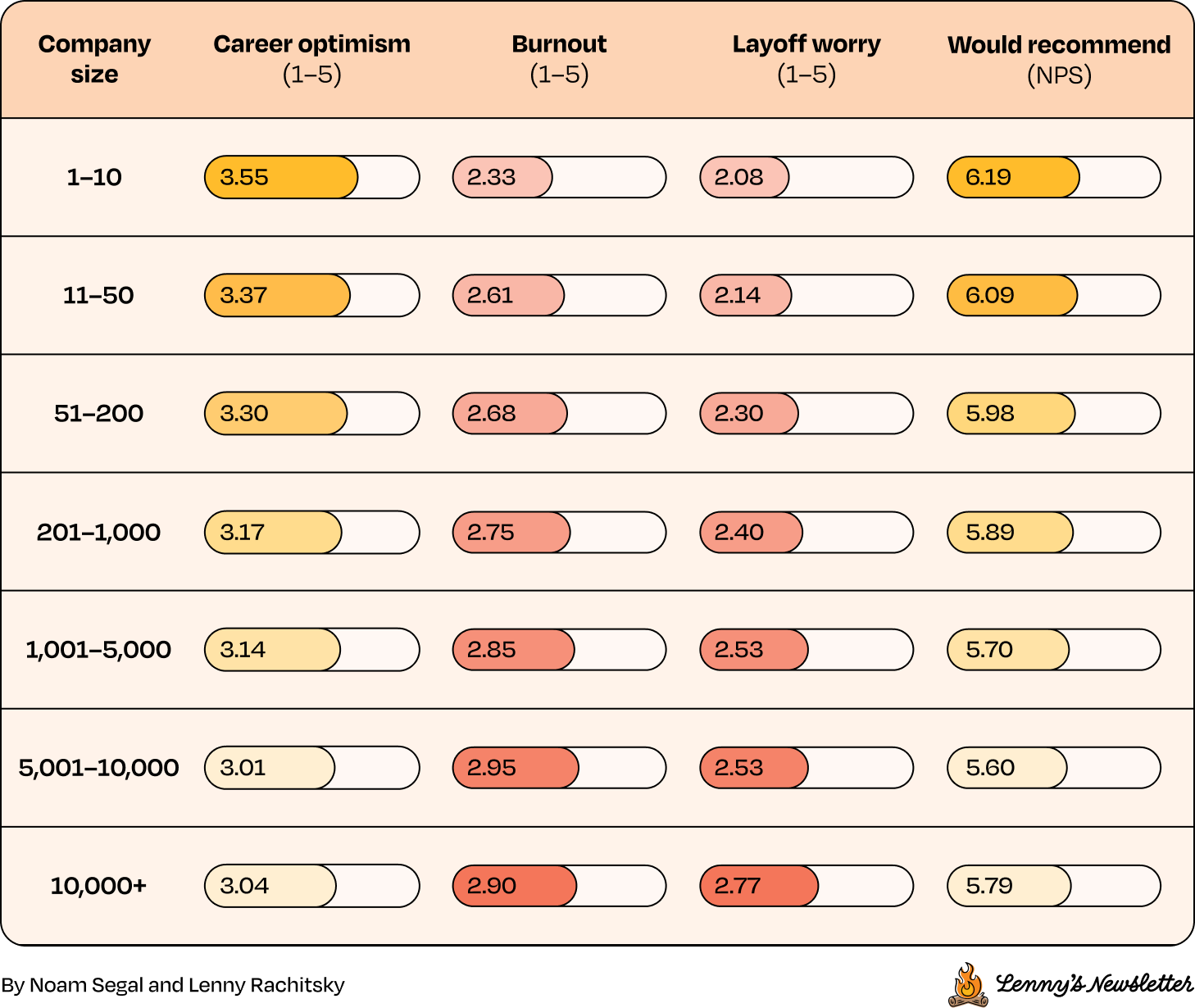
People at small companies are more optimistic, less burned out, less worried about layoffs, and even feel AI is helping them more, likely because they have more freedom to actually use it. The “big-company blues” we described last year have settled in.
小公司的人更乐观、倦怠更少、更不担心裁员,甚至觉得 AI 对他们帮助更大——很可能是因为他们有更多自由去真正用起来。我们去年描述的"大公司忧郁"已经彻底安家落户。
Look at the absolute numbers, though, not just the slope. Even at the smallest companies, 42% of people are at least moderately burned out, and the would-recommend score never climbs out of the red, sitting at –28 at 1-to-10-person shops. Small companies are winning a race to the least bad.
不过,要看绝对数字,而不只是斜率。即便在最小的公司,也有 42% 的人至少处于中度倦怠,而"是否愿意推荐"的分数从未爬出红区,在 1 到 10 人的小作坊里也只有 –28。小公司赢的,是一场"谁最不糟"的竞赛。
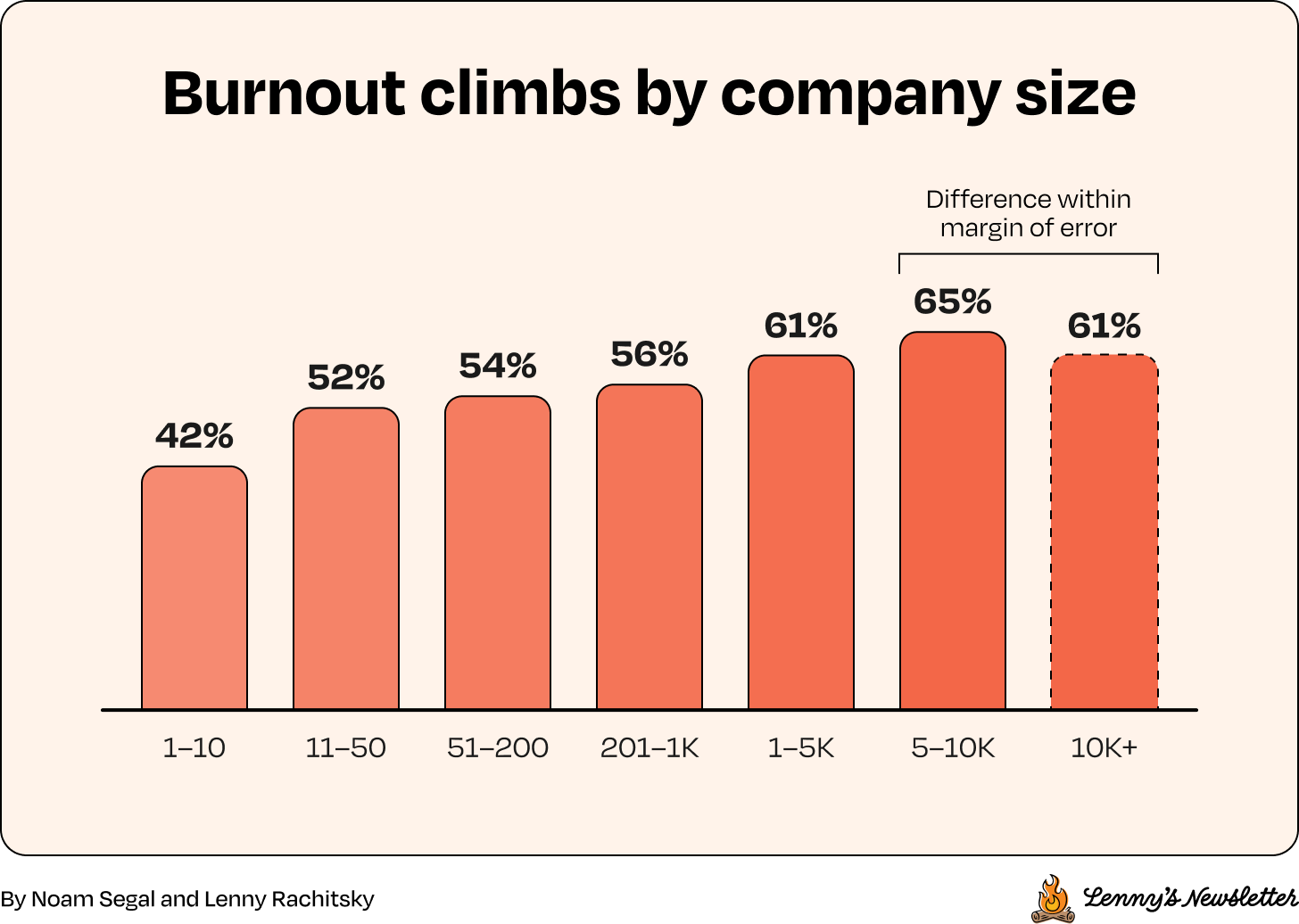
Two smaller echoes of 2025:Where you physically work still hardly matters. There are barely any differences between how fully remote, hybrid, and in-office workers feel. Hybrid workers come out marginally the happiest (and in-office workers rate their managers the worst), but the gaps are small, just as we found last year. Employment type tells a familiar story with one twist. Founders and the self-employed are the happiest and least burned out, while contractors and freelancers are an interesting split—they are among the least burned out (less of the grind) but the most worried about layoffs (no job security).
还有两处 2025 年的小回响:你在哪里办公,依然几乎无关紧要。完全远程、混合和坐班的员工,感受之间几乎没有差别。混合办公的员工略微是最幸福的(而坐班员工对经理的评价最差),但差距很小,和我们去年发现的一样。用工类型讲的是一个熟悉的故事,只是多了一个转折。创始人和自雇者最幸福、倦怠最少,而合同工和自由职业者则呈现出一个有趣的分裂——他们属于倦怠最少的一群(少了那份日复一日的煎熬),却又是最担心裁员的(没有工作保障)。
One wrinkle you may have noticed: the largest companies (10,000+) tick up slightly in optimism and down in burnout compared with the 5,001–10,000 tier, breaking the smooth gradient. But neither difference is statistically significant (5,001–10,000 is our smallest sample), so the line flattens at the top rather than reversing. The one measure that does keep climbing to the very top is layoff worry. Workers at 10,000-plus-person companies are the most worried of anyone in the survey.
你可能注意到一个褶皱:与 5,001–10,000 人这一档相比,最大的公司(10,000 人以上)在乐观度上略有回升、倦怠略有下降,打破了那条平滑的梯度。但这两处差异在统计上都不显著(5,001–10,000 是我们样本量最小的一档),所以这条线在顶端是趋平,而非反转。唯一一路攀升到最顶端的指标是裁员担忧。1 万人以上公司的员工,是整个调查中最担心裁员的一群。
Takeaway 9: Managers are still the biggest lever for happiness
One more finding held firm from last year, and it may be the most actionable of all. Manager effectiveness remains the strongest driver of burnout in the entire dataset (it beats role, company size, and AI sentiment), and one of the strongest drivers of everything else. The gradient is dramatic:
还有一个去年的发现今年依然稳固,而它或许是所有发现中最具可操作性的一个。经理的有效性仍是整个数据集中最强的倦怠驱动因素(它超过了角色、公司规模和 AI 情绪),也是其他几乎所有指标最强的驱动因素之一。这条梯度非常戏剧化:
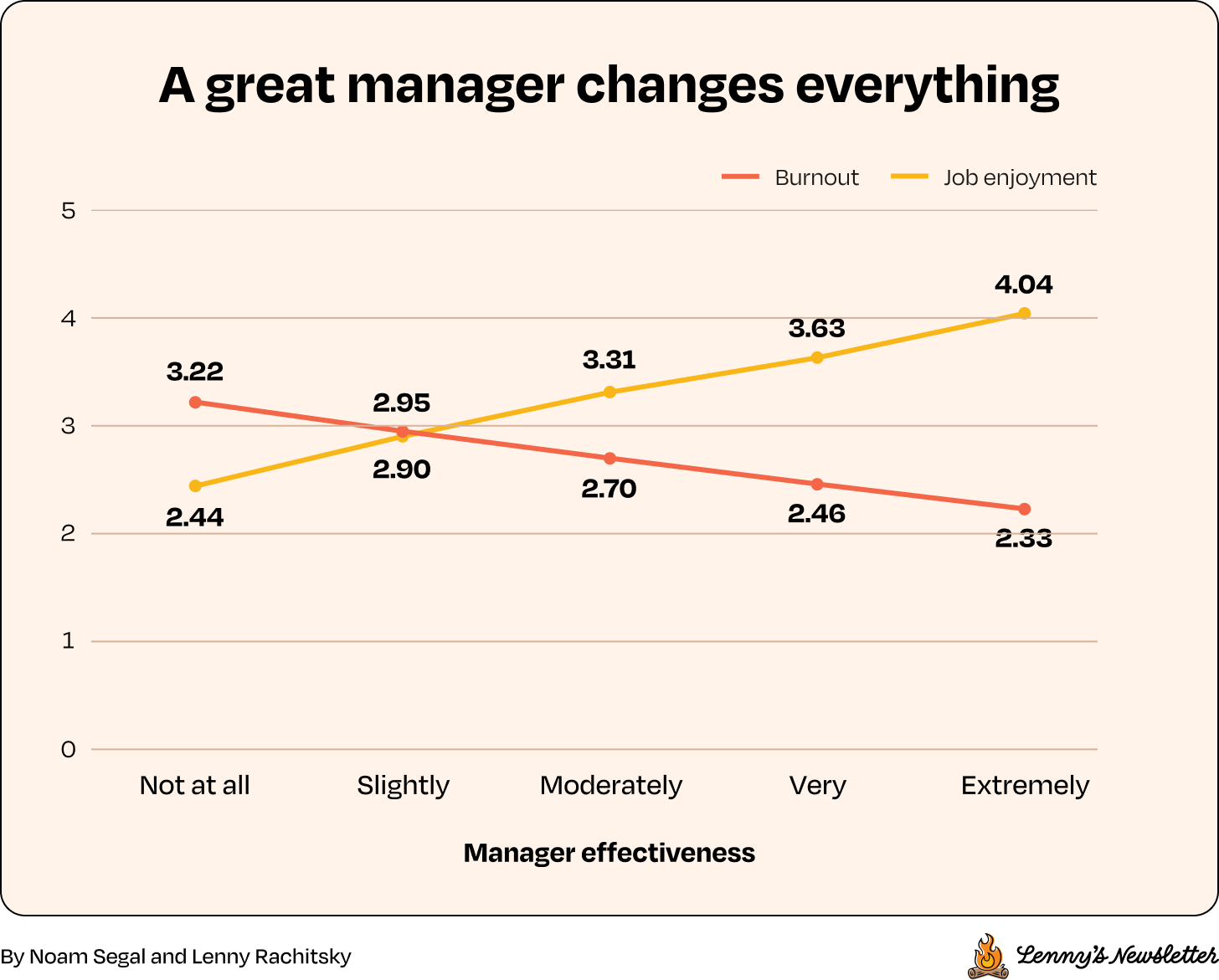
Workers with an extremely effective manager report roughly 65% higher job enjoyment and dramatically lower burnout than those with an ineffective one. Yet only 25.5% of tech workers rate their manager as highly effective, while 36.5% rate theirs as ineffective, numbers that have barely budged since last year. The most powerful retention lever in tech is also the most neglected. (Notably, the worst-rated managers cluster in Data/Analytics and Design. The latter is a double blow, since designers are also among the most AI-anxious.)
拥有一位极其称职的经理的员工,工作享受度大约要高出 65%,倦怠也远低于那些经理不称职的员工。然而只有 25.5% 的科技从业者认为自己的经理非常称职,却有 36.5% 认为经理不称职——这些数字自去年以来几乎没有变化。科技行业里最强大的留存杠杆,同时也是最被忽视的一个。(值得注意的是,评分最差的经理集中在数据/分析和设计领域。后者是双重打击,因为设计师同时也属于对 AI 最焦虑的群体。)
Takeaway 10: The industry is “chaotic”
We asked, “In a sentence, how would you describe the state of the tech industry right now?” About 70% of respondents answered, and the single most common theme, by a wide margin, was chaos: roughly three in 10 explicitly used words like change, chaotic, uncertain, unstable, and in flux. Another one in six described an industry moving too fast to keep up with—treadmills, hamster wheels, hurricanes, “drinking from a firehose.” After that came AI hype and bubble talk (12%) and then, finally, a note of excitement and opportunity (11%).
我们问道:"用一句话,你会怎么形容当下科技行业的状态?"约 70% 的受访者作答,而遥遥领先、出现频率最高的主题就是混乱:大约每 10 人里就有 3 人明确用了诸如 change(变化)、chaotic(混乱)、uncertain(不确定)、unstable(不稳定)、in flux(动荡不定)这样的词。另有六分之一的人形容这是一个快到跟不上的行业——跑步机、仓鼠轮、飓风、"像用消防水龙头喝水"。再往后是关于 AI 炒作和泡沫的讨论(12%),最后才是一丝兴奋与机遇的语气(11%)。
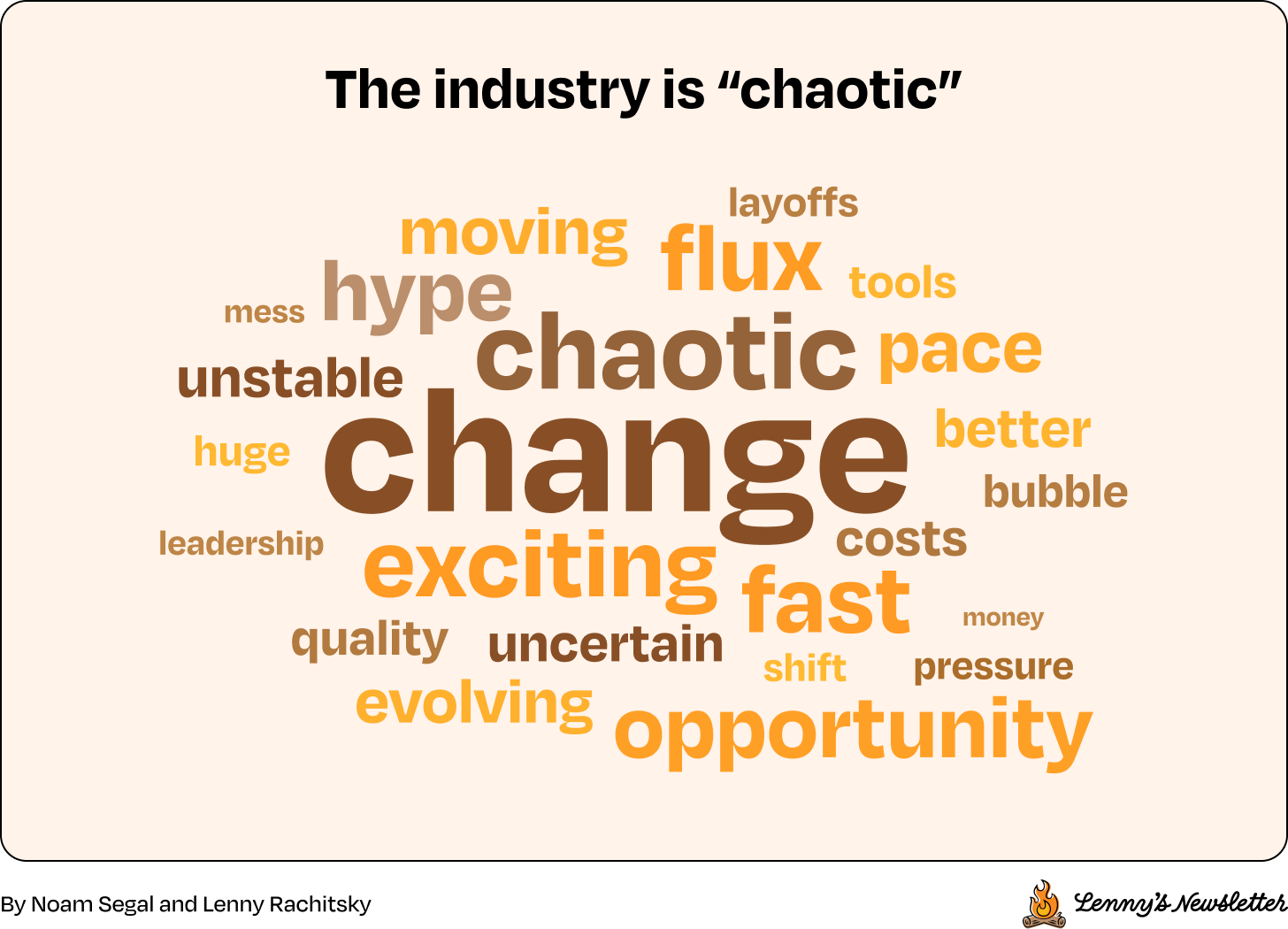
A few responses capture the sentiment better than any percentage can:
有几条回答,比任何百分比都更能捕捉到这种情绪:
“We’re in the 2nd inning of a massive shift, and no one knows how it will end, but all you can do is keep taking at-bats.”
“It feels like working on pure software is like picking up pennies in front of a steamroller.”
“The industry feels like it has lost its center of gravity—replacing curiosity about customers with an obsession over AI, automation, and efficiency.”
The chaos plus hype is well-described in this quote from a senior PM:
这种混乱加炒作,被一位资深 PM 的话精准地描述了出来:
“Manic. Half are out of touch, clinging to the bandwagon, making the problem worse by pouring into the overhype. The other half are exhausted by the first half.” —Senior IC PM
When we ran sentiment analysis on the chaos-related quotes, the split was nearly even: 37% positive, 37% negative, and 26% neutral. The dominant theme is disorientation, but the emotional charge is truly bimodal. The same churn reads as thrilling to one person and terrifying to the next.
当我们对这些与混乱相关的引言做情绪分析时,分布几乎是均等的:37% 正面、37% 负面、26% 中性。占主导的主题是迷失方向,但情绪的正负却真正呈现出双峰分布。同样的动荡,在一个人读来是激动人心,在另一个人读来却是惊恐万分。
We confirmed this by splitting the responses by who wrote them. Career optimists and career pessimists describe the same industry in opposite terms. Optimists reach for “exciting,” “transforming,” “opportunity,” “fast-moving.” Pessimists reach for “chaos,” “layoffs,” “greed,” “dystopia.” Same disruption, opposite forecasts: half the room is anxiously bracing for AI’s impact; the other half is eagerly leaning into the AI era.
我们通过按作答者身份切分回答,证实了这一点。职业乐观者和职业悲观者,用截然相反的措辞描述着同一个行业。乐观者伸手去抓"exciting(激动人心)""transforming(正在变革)""opportunity(机遇)""fast-moving(快速演进)"。悲观者伸手去抓"chaos(混乱)""layoffs(裁员)""greed(贪婪)""dystopia(反乌托邦)"。同样的颠覆,相反的预测:屋子里一半人正焦虑地为 AI 的冲击做准备,另一半人则热切地拥抱 AI 时代。
Where do we go from here?
The 2026 workforce is more burned out and less optimistic than a year ago, splitting along the fault line of AI into those who are thriving and those who are struggling, and a large, ambivalent middle caught between. Tech workers are mostly afraid of being squeezed by their jobs and increasing productivity expectations, privately convinced the field is no longer worth recommending to newcomers, while individually still finding real power and even joy in the tools. It’s a complicated moment. It’s also not a hopeless one.
2026 年的科技从业者比一年前更加倦怠、也更不乐观,并沿着 AI 这条断层线分裂成两群人:一群如鱼得水,一群举步维艰,中间还夹着庞大而矛盾的“中间派”。大多数科技从业者害怕被工作和不断攀升的生产力预期压垮,私下里认定这个行业已经不值得再推荐给新人;但落到个人身上,他们又依然能从这些工具里获得真实的力量,甚至乐趣。这是一个复杂的时刻,但也并非一个绝望的时刻。
So here’s what the data suggests you can actually do about it.
所以,以下是数据所揭示的、你真正能为此做点什么的建议。
If you’re an employee:
如果你是一名员工:
· Find something impactful to do with AI—then go deep. The “amplified” are the people who found the two or three tasks where AI measurably changed their output and got very good at those. Trying to use AI for everything is how you end up overwhelmed and conflicted, not empowered.
· 找到一件能靠 AI 做出影响力的事——然后深挖下去。那些“被放大”的人,是找到了两三项 AI 能切实改变其产出的任务,并把这些任务做到极致的人。想用 AI 干所有事,只会让你不堪重负、内心矛盾,而不是被赋能。
· Watch the squeeze. The biggest career risk is silently absorbing a higher and higher bar for the same pay until you’re burned out. Take our burnout test here, and if your output has doubled this year, talk to your manager about scope and compensation.
· 警惕那种“挤压”。最大的职业风险,是在薪水不变的情况下,悄无声息地承受着越来越高的标准,直到你精疲力竭。点这里做我们的倦怠测试,如果你今年的产出翻了一倍,就去和你的经理谈谈职责范围和薪酬。
· Your manager matters more than almost anything. A great manager is associated with about 65% higher job enjoyment and far less burnout. If you have one, protect that relationship. If you don’t, getting closer to a better one may be the highest-leverage career move available to you.
· 你的经理几乎比任何事都更重要。一位优秀的经理,与高出约 65% 的工作愉悦度以及低得多的职业倦怠相关。如果你有这样一位经理,请守护好这段关系。如果没有,那么向一位更好的经理靠拢,或许是你眼下杠杆率最高的职业动作。
· Consider a smaller company—or your own. Every well-being measure in this survey improves as company size shrinks, and founders are the happiest group in tech. More autonomy and control is, year after year, the most reliable buffer against burnout and pessimism we find.
· 考虑去一家更小的公司——或者自己创业。这份调查里的每一项幸福感指标,都随着公司规模的缩小而改善,而创始人是科技圈里最快乐的群体。年复一年,更多的自主权和掌控感,始终是我们发现的、对抗倦怠与悲观最可靠的缓冲。
· If you’re early-career, find mentors. The rungs are disappearing, but strong mentorship remains highly effective. Seek the teams and managers who still invest in developing people. That investment is rarer and more valuable than it’s ever been.
· 如果你处于职业早期,去找导师。晋升的台阶正在消失,但强有力的师徒指导依然极为有效。去寻找那些仍然愿意投入去培养人的团队和经理。这样的投入比以往任何时候都更稀缺、也更宝贵。
If you lead a team or company:
如果你领导着一个团队或一家公司:
· Invest in managers—it’s still the best money you’ll spend. Only a quarter of tech workers rate their manager as highly effective, and nothing else in the data moves burnout, enjoyment, and retention as much. This was our top recommendation last year. It’s our top recommendation again.
· 在经理身上投资——这仍然是你能花的最值的钱。只有四分之一的科技从业者认为自己的经理非常称职,而在数据中,没有任何其他因素能像这一项一样,如此大幅地影响倦怠、愉悦度和留存。这是我们去年的头号建议,今年它仍是我们的头号建议。
· Manage the squeeze. Your people can feel AI raising the bar, and they’re watching to see whether you turn productivity gains into impossible expectations or actual relief. The fastest way to end up with resentment on your team is to pocket the productivity and turn saved time into more work for them.
· 管理好那种“挤压”。你的员工能感觉到 AI 正在抬高标准,他们也在观察:你究竟是把生产力的提升变成了不可能完成的预期,还是变成了实实在在的减负。让团队积怨的最快方式,就是把生产力收进自己口袋,把省下来的时间转化成让他们干更多的活。
· Don’t let the bottom rung rot. If AI is doing the entry-level work that juniors used to learn on, you’re optimizing this year’s output by starving next year’s senior talent. Be deliberate about how early-career people develop when the old apprenticeship tasks are gone.
· 别让最底层的台阶烂掉。如果 AI 正在做那些初级员工过去赖以学习成长的入门工作,那你其实是在用扼杀明年的资深人才为代价,来优化今年的产出。当旧的“学徒式”任务已不复存在时,要有意识地去规划职业早期的人该如何成长。
· Pay special attention to design and research. For two years running, people in these roles report the worst sentiment, the highest AI anxiety, and some of the worst-rated managers. That’s a retention problem and a signal worth understanding before it becomes an exodus.
· 格外关注设计和研究岗。连续两年,这两类岗位的人报告出最差的情绪、最高的 AI 焦虑,以及一些评价最差的经理。这是一个留存问题,也是一个值得在它演变成离职潮之前就去理解的信号。
· Treat AI adoption as a sorting risk rather than a productivity win. The same technology is lifting one part of your workforce while destabilizing another. The companies that come out of this ahead will help support the destabilized group instead of leaving them behind.
· 把 AI 的采用视为一种“分化风险”,而不是一场生产力胜利。同一项技术,正在托举你员工中的一部分人,同时让另一部分人陷入动荡。最终能从这一切中胜出的公司,会去支持那些被动荡波及的群体,而不是把他们抛在身后。
The throughline, if there is one, is the same as last year’s: Having the most advanced AI or the fanciest offices won’t determine which organizations succeed. Remembering that there are people underneath all this change will—people who, right now, are excited and exhausted, hopeful and scared, often all at once. Those people are watching closely to see whether the future they’re helping to build will still have a place for them.
如果说有一条贯穿始终的主线,那它和去年是一样的:决定哪些组织能够成功的,不是拥有最先进的 AI 或最气派的办公室,而是记住这一切变革之下站着的是活生生的人——那些此刻既兴奋又疲惫、既满怀希望又心怀恐惧、且常常是这些情绪一并涌上心头的人。这些人正在密切观察:他们正在亲手参与构建的未来,是否还会为他们留有一席之地。
Huge thanks to the 5,920 tech professionals who shared how they’re really feeling. Your candor is what makes this possible, and it’ll help us keep tracking where the industry is headed. 🙏
衷心感谢分享了自己真实感受的 5,920 位科技专业人士。是你们的坦诚让这一切成为可能,它也将帮助我们持续追踪这个行业的走向。🙏
Have a fulfilling and productive week.
祝你度过充实而高效的一周。
Noam (and Lenny) 👋
Noam(以及 Lenny)👋
Appendix: Who took this survey?
This year’s survey reached 5,920 tech professionals, of whom 5,332 are currently working. All analyses are based on currently employed tech workers.
今年的调查触达了 5,920 位科技专业人士,其中 5,332 人目前在职。所有分析都基于当前在职的科技从业者。
Role. As with last year, this is a product-centric audience: Product Management 46.9%, Engineering 12.6%, Founder/Executive 9.1%, Design 7.9%, Operations 4.3%, Product Marketing 4.0%, Research 3.2%, Data/Analytics 2.9%, Sales/GTM 2.8%, with a long tail of other functions.
岗位。与去年一样,这是一个以产品为核心的受众群体:产品管理 46.9%,工程 12.6%,创始人/高管 9.1%,设计 7.9%,运营 4.3%,产品营销 4.0%,研究 3.2%,数据/分析 2.9%,销售/GTM 2.8%,还有一条由其他各类职能构成的长尾。
Seniority. A senior crowd: IC–Senior 28.9%, IC–Staff/Principal 19.9%, Director 15.4%, Manager 12.1%, Founder/Exec 10.8%, VP+ 7.4%, and IC–Early career 5.5%. Roughly 54% individual contributors and 46% managers and above.
资历。这是一群偏资深的人:IC—资深 28.9%,IC—Staff/Principal 19.9%,总监 15.4%,经理 12.1%,创始人/高管 10.8%,VP 及以上 7.4%,IC—职业早期 5.5%。大致 54% 为个人贡献者(IC),46% 为经理及以上。
Company size. A fairly even spread, from 1–10-person startups (11.1%) up through 10,000-plus-person enterprises (18.0%), with the middle bands well represented.
公司规模。分布相当均匀,从 1—10 人的初创公司(11.1%)一直到 10,000 人以上的大型企业(18.0%),中间各档也都有充分的代表性。
Work setup. Fully remote 47.0%, hybrid 43.0%, fully in-office just 10.0%.
工作方式。完全远程 47.0%,混合办公 43.0%,完全坐班仅 10.0%。
A methodological note for the careful reader: We made year-over-year comparisons only for questions whose wording matched across years. We redesigned much of the survey this year to focus on AI, which means a few 2025 themes (engagement, belonging, quitting intentions, career clarity) aren’t measured here, while others (layoff worry, the AI block, the career-recommendation score) are new. We also didn’t collect age, tenure, or geography this year, so when we discuss career stage, we’re using job level as a proxy.
给细心读者的一点方法论说明:我们只对那些历年措辞一致的问题做了同比比较。今年我们对调查做了大幅重新设计,聚焦于 AI,这意味着 2025 年的一些主题(参与度、归属感、离职意愿、职业清晰度)在这里没有被测量,而另一些(裁员担忧、AI 板块、职业推荐评分)则是新增的。今年我们也没有采集年龄、司龄或地域信息,所以当我们讨论职业阶段时,是用职级作为代理指标的。
If you’re finding this newsletter valuable, share it with a friend, and consider subscribing if you haven’t already. There are group discounts, gift options, and referral bonuses available.
如果你觉得这份 newsletter 有价值,把它分享给一位朋友吧,如果你还没订阅,也不妨考虑订阅。我们提供团体折扣、赠送选项以及推荐奖励。
Sincerely,
此致,
Lenny 👋
Lenny 👋
4771265SharePreviousNextA guest post byNoam SegalSubscribe to NoamDiscussion about this postCommentsRestacksMitchell Kosowski 2dLiked by Lenny Rachitsky, Noam SegalThe killer stat: the correlation between "AI is replacing parts of my job" and layoff worry is essentially zero (r = +0.05). The replacement narrative dominates headlines but the real fear is the squeeze in that every productivity gain instantly becoming the new baseline.
4771265分享上一篇下一篇一篇客座文章,作者Noam Segal订阅 Noam关于这篇文章的讨论评论转发Mitchell Kosowski 2天前获 Lenny Rachitsky、Noam Segal 点赞最关键的数据:“AI 正在替代我工作的一部分”与裁员担忧之间的相关性基本为零(r = +0.05)。替代论主导了各种头条,但真正的恐惧是那种“挤压”——每一分生产力的提升,都会立刻变成新的基准线。
That reframes the manager finding too: if manager quality is still the biggest burnout lever, the leadership test of 2026 is whether saved time gets returned to people or pocketed as higher expectations. Curious whether next year's survey shows any companies passing that test.
这也重新诠释了关于经理的那个发现:如果经理质量仍是最大的倦怠杠杆,那么 2026 年对领导力的考验就在于——省下来的时间究竟是还给了员工,还是被收进口袋、变成了更高的预期。我很好奇明年的调查会不会显示有哪些公司通过了这场考验。
The optimism/pessimism gaps by profession make a lot of sense - if you’re a founder or exec you’re in control of who keeps their job and you tend to make more. Chances are you’re safer financially than everyone else.
不同职业之间的乐观/悲观差距很有道理——如果你是创始人或高管,你手里掌握着谁能保住饭碗的决定权,而且你往往挣得更多。你在财务上很可能比其他所有人都更安全。
Which sucks. Most of us aren’t in roles like that but are subject to others in power making decisions about our lives.
这很糟糕。我们大多数人都不在那样的岗位上,而是任由那些掌权者替我们的人生做决定。
Which kind of feels like the vibe of AI populism in general these days.
这某种程度上正是当下 AI 民粹主义的整体氛围。
ReplyShare1 reply10 more comments...TopLatestDiscussionsNo posts
回复分享1 条回复还有 10 条评论...最热最新讨论暂无帖子