The Mom-and-Pop SaaS Era Has Arrived
“This isn’t primarily a developer productivity story. Instead, it’s an economic participation story.”
为什么 AI 不是在杀死软件,而是在放大它
-
真正的变革不是提效,是“造什么”变了
“But the really big deal is that when AI dramatically lowers the cost of creating software, entirely new markets and categories become economically viable.”
“This isn’t primarily a developer productivity story. Instead, it’s an economic participation story.”
开发者写得更快只是表象;AI 把做软件的成本打下来,真正解锁的是过去“账算不过来”的全新市场和品类。
-
一个人,就能是一家软件公司
“the builder economy is teaching us that one person can become a software company.”
“And just like Shopify transformed millions of people into merchants, AI-powered software creation is transforming millions of people into software builders.”
创作者经济让一个人能当一家媒体公司;构建者经济正让一个人能当一家软件公司——Shopify 造商家,AI 造软件构建者。
-
未来的优势是领域专长,不是技术
“The future advantage may no longer be technical expertise - it may be domain expertise!”
“80% of builders come from non-technical backgrounds. Even more interesting: 55% of builders have >11 years of professional experience.”
Lovable 数据:80% 构建者非技术出身、55% 有 11 年以上职业经验;真正稀缺的是行业积累,不是会不会写代码。
-
离问题最近的人,直接造解法
“But now the person closest to the problem becomes the person creating the solution.”
“A subject matter expert would explain their world to a developer. That translation layer was always imperfect, which produced (mostly) shitty software.”
过去领域专家把需求“翻译”给开发者,这层翻译永远失真、产出烂软件;如今最懂问题的人自己动手,翻译层没了。
-
玩票和独角兽之间,才是甜蜜点
“But there’s a huge middle ground between hobby project and unicorn.”
“You don’t have to be Salesforce to be a highly profitable software business. The whole VC-industrial complex trained all of us to believe that every software company should pursue literally world-changing outcomes and 10-figure exits.”
不必做成 Salesforce 也能赚钱;VC 工业复合体让人误以为每家软件公司都得改变世界、十位数退出——其实中间地带最好做。
-
SaaS 没死,是软件经济变大了
“Instead of a world powered by a few thousand software companies, we’ll have a world powered by millions of builders.”
“That’s why I don’t think we’re watching the end of software. I think we’re witnessing the beginning of a much larger software economy than the one we’ve had before.”
会死的只是“软件公司必须像风投硅谷创业公司”的旧观念;取而代之的是几千家公司→数百万构建者的更大软件经济。
The Real Shift Isn’t Faster Devs
So many stories about AI focus on developer productivity or replacing developers altogether.
关于 AI 的故事,太多都盯着开发者的生产力,或者干脆聊怎么取代开发者。
And sure, non-technical teams can launch their own stuff.
当然,非技术团队也能自己上线点东西。
But that framing misses the bigger shift.
但这个视角漏掉了更大的转变。
The real change is what type of software is now getting built.
真正的变化是:现在被造出来的到底是哪种软件。
For decades, creating software required access to a small, highly specialized group of people concentrated in a handful of tech hubs and funded by venture capital.
几十年来,做软件得动用一小群高度专业化的人,他们集中在少数几个科技中心,靠风险投资养着。
That meant only ideas large enough to justify those costs ever made it into the world.
这就意味着,只有大到撑得起这些成本的点子,才有机会问世。
As the cost and complexity of building collapse, that constraint disappears.
而当构建的成本和复杂度一路崩塌,这道门槛就消失了。
The winners won’t just be faster developers.
赢家不会只是手更快的开发者。
They’ll be teachers, real estate agents, accountants, coaches, consultants, small business owners, and domain experts of every kind solving problems they understand deeply.
他们会是老师、房产中介、会计、教练、顾问、小企业主,以及各行各业的领域专家——去解决那些他们理解得极深的问题。
The future of software won’t be defined by a tiny group of elite builders.
软件的未来,不会由一小撮精英构建者来定义。
The future of software will be defined by everyone else.
软件的未来,由其他所有人来定义。
Get ready to start seeing (and hopefully building) more and more products from unexpected places.
准备好吧,你会看到(但愿也会亲手做出)越来越多来自意想不到之处的产品。
This will be software built by local experts with limited technical experience, but way more experience in everything else.
这些软件出自本地专家之手,他们技术经验有限,但其他方面的经验多得多。
I call this Mom-and-Pop SaaS!
我管这叫夫妻店 SaaS!
Better output is not.
但更好的产出没有。
Download the Work AI Index Report to see why workers save 11 hours a week but still hit the productivity paradox, what botsitting and botshitting (I learned a new term, ha!) are costing teams, and what high AI achievers do differently. → Read it now!
下载 Work AI Index Report,看看为什么员工每周省下 11 小时却依然撞上生产力悖论、botsitting and botshitting(我学了个新词,哈!)正让团队付出多少代价,以及 AI 高手的做法有何不同。→ Read it now!
And by Amplitude: build better products with our AI analytics platform.
以及由 Amplitude 赞助:用我们的 AI 分析平台造出更好的产品。
With powerful AI Agents embedded across our platform, teams can analyze, test, and optimize user experiences faster than ever. →Get started for free!
强大的 AI Agents 嵌入平台各处,团队分析、测试、优化用户体验的速度比以往任何时候都快。→Get started for free!
When the Software Math Wasn’t Mathing
Software building has been ridiculously expensive in the past.
过去,做软件贵得离谱。
Want a website?
想要个网站?
That will cost you a few thousand bucks.
那得花你好几千块。
Want a small app or integration?
想要个小 App 或者做个集成?
Get ready for a 5 digit price tag (if you are hiring offshore, otherwise add another 0).
准备好迎接一个五位数的价签吧(前提是你雇离岸团队,否则再加个零)。
And listen, it was warranted.
而且说真的,这钱花得值。
Good software engineers don’t just know multiple coding languages, they also understand all of the complex structures underneath the surface that make it all work.
好的软件工程师不只会好几门编程语言,还吃透了表面之下那些让一切运转的复杂结构。
It took time to learn and get good at, so it was v pricey.
这东西学起来、练到精通都要花时间,所以贵得很。
And when the cost is high, the price must be high to make the math work.
而当成本高企,价格也必须高,账才算得过来。
Software developers demanded (and deserved) high salaries, and people that wanted to work with them inevitably drifted toward massive markets and massive opportunities.
软件开发者要求高薪(也配得上),而想跟他们合作的人,不可避免地都涌向了巨大的市场和巨大的机会。
(What was the number one question in software companies?: ‘WHAT’S YOUR TAM???’ It better have ‘B’ as the first letter haha)
(软件公司里的头号问题是啥?——‘你的 TAM 有多大???’最好第一个字母就是个 ‘B’ 哈哈)
The result is that thousands of perfectly good ideas never got built.
结果就是,成千上万个相当不错的点子,从来没被做出来。
Because software math was not mathing for them.
因为对它们来说,软件这笔账根本算不过来。
There are so many industries, professions, communities, hobbies, and niches that desperately needed software but could never justify the cost of creating it.
有那么多行业、职业、社区、爱好和小众领域,极度需要软件,却永远撑不起开发它的成本。
A local soccer club, a vacation rental operator, an orthodontist, a wedding photographer, a recruiter, a teacher, an artist … The list is infinite.
一家本地足球俱乐部、一个做度假租赁的、一个牙齿矫正医生、一个婚礼摄影师、一个招聘者、一个老师、一个艺术家……这份名单没完没了。
Like what you are reading?
喜欢你正在读的内容吗?
Subscribe to my blog!
订阅我的博客!
So, yeah, developers writing code faster is cool.
所以,没错,开发者写代码更快,是挺酷。
But the really big deal is that when AI dramatically lowers the cost of creating software, entirely new markets and categories become economically viable.
但真正了不起的是:当 AI 把做软件的成本猛地拉低,全新的市场和品类在经济上就变得可行了。
We’ve Seen This Before
Let’s not forget that this pattern has happened before:
别忘了,这套路以前就上演过:
• Shopify didn’t create commerce.
• Shopify 没有创造商业。
• But it *did* create millions of new merchants.
• 但它*确实*创造了数百万新商家。
• Airbnb didn’t create hospitality.
• Airbnb 没有创造酒店业。
• But it *did* create new properties available for rent & hosts.
• 但它*确实*创造了可供出租的新房源和新房东。
• YouTube didn’t create entertainment.
• YouTube 没有创造娱乐。
• It *did* create a new type of creators that specialize in niche interests.
• 但它*确实*创造了一种专攻小众兴趣的新型创作者。
• Substack didn’t create writers.
• Substack 没有创造作家。
• It *did* create a new wave of independent media businesses.
• 但它*确实*创造了新一波独立媒体生意。
And by the way, all of these examples did not eliminate the original category offerings - Nike is still in business.
顺便说一句,这些例子没有一个消灭了原有品类——Nike 还好好开着店。
So are the Hilton hotels.
Hilton 酒店也是。
And movie theaters with blockbuster movies.
放着大片的电影院也是。
And magazines are still alive (I think?).
杂志也还活着(大概吧?)。
The increased economic viability historically expanded the categories, rather than just reshuffling existing demand.
从历史看,经济可行性一提升,往往是把品类做大了,而不只是把现有需求重新洗一遍牌。
There’s even a fancy economic theory for this, called Jevons Paradox.
这甚至有个花哨的经济学理论撑腰,叫杰文斯悖论(Jevons Paradox)。
Essentially, when a new technology makes it more efficient to use a resource… the demand for that resource goes up, not down.
本质上,当新技术让某种资源用起来更高效时……对这种资源的需求反而会上升,而不是下降。
This originally came up because this guy (Jevons) noticed that British steam engines got more efficient… which didn’t lead to using less coal.
这个说法最早冒出来,是因为杰文斯这家伙注意到,英国的蒸汽机变高效了……却并没有让人们少烧煤。
Coal usage 3x’d!
煤炭用量翻了 3 倍!
Same for fuel-efficient cars that mean people drive further, or LED lights that use less electricity, which means we put ‘em on everything.
省油的车也一样,人们于是开得更远;省电的 LED 灯也一样,于是我们把它装到了一切东西上。
So it makes sense that as software creation is becoming crazy cheap, we’ll get more of it, rather than less.
所以道理很顺:随着做软件便宜到发疯,我们只会得到更多软件,而不是更少。
And when the economics of creating something disappear, completely new groups of people can enter the market.
而当造东西的经济门槛消失,全新的人群就能涌进这个市场。
And just like Shopify transformed millions of people into merchants, AI-powered software creation is transforming millions of people into software builders.
就像 Shopify 把数百万人变成了商家,AI 驱动的软件创造正把数百万人变成软件构建者。
That’s why I think many people are looking at this moment through the wrong lens.
这就是为什么我觉得,很多人正用错误的镜头看待这一刻。
This isn’t primarily a developer productivity story.
这首先不是一个开发者生产力的故事。
Instead, it’s an economic participation story.
恰恰相反,这是一个经济参与的故事。
The Data Backs It Up
At Lovable, we recently studied the people building on our platform.
在 Lovable,我们最近研究了在自家平台上做东西的这群人。
The results were cool to see:
结果挺带劲:
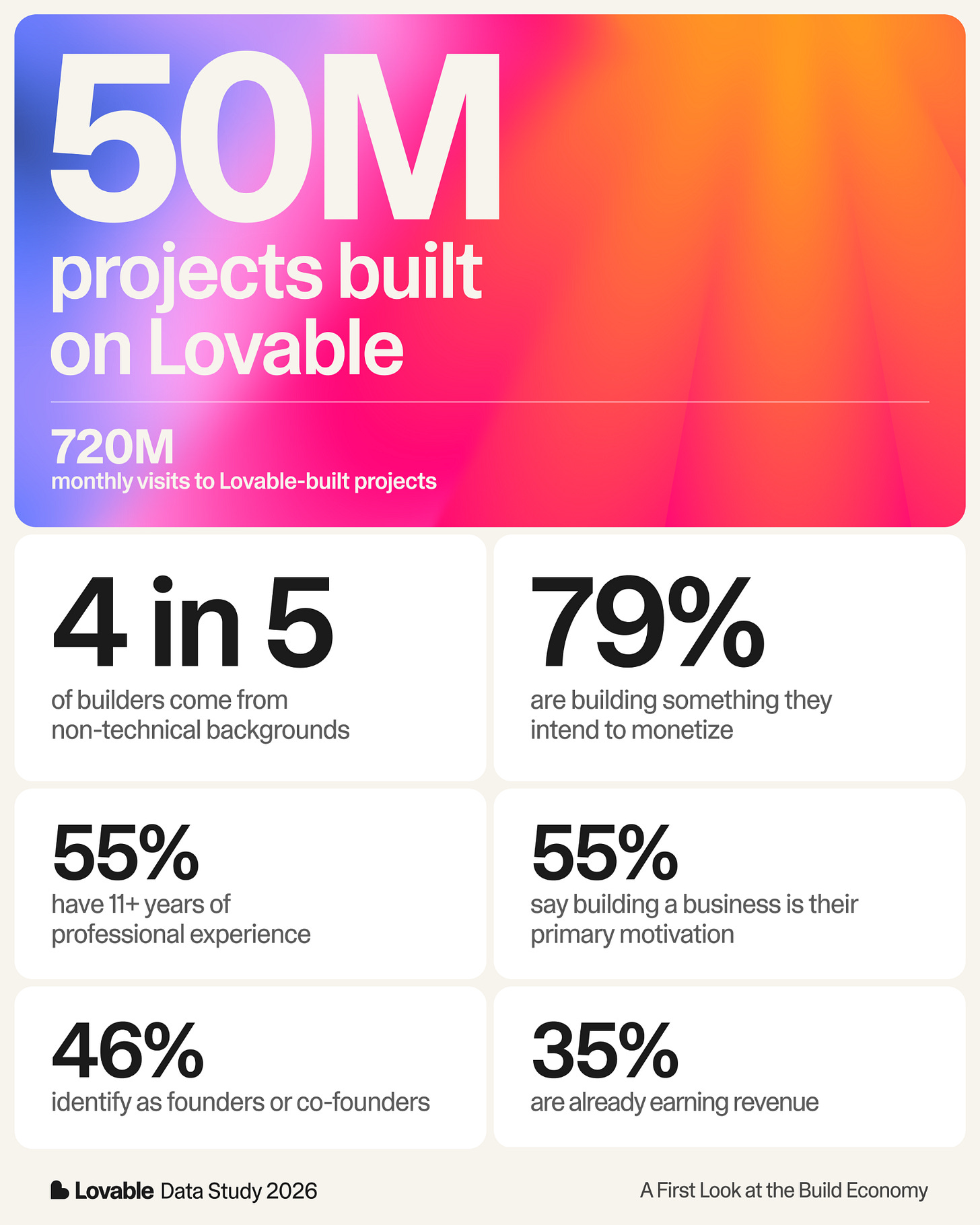
• 80% of builders come from non-technical backgrounds.
• 80% 的构建者来自非技术背景。
Think about that for a second.
花一秒钟琢磨琢磨这事。
This has never been possible before!
这在以前从来做不到!
In the past, software creation was limited to just the people who already had these technical skills.
过去,做软件只属于那些本就握有这些技术技能的人。
Today, the overwhelming majority of these builders are people with a completely different set of past experiences.
而今天,这些构建者里绝大多数,是过往经历完全不同的一群人。
• Even more interesting: 55% of builders have >11 years of professional experience.
• 更有意思的是:55% 的构建者有超过 11 年的职业经验。
The future advantage may no longer be technical expertise - it may be domain expertise!
未来的优势也许不再是技术专长——而是领域专长!
People are taking a decade or more of accumulated expertise and packaging it into software.
人们正把积累了十年甚至更久的专长,打包成软件。
Boom.
就这么简单。
Software development used to work the opposite way.
软件开发过去恰恰是反着来的。
A subject matter expert would explain their world to a developer.
一个领域专家,得先向开发者讲清楚自己那个世界。
The developer would attempt to understand the workflow, requirements, exceptions, edge cases, and user needs before translating all of that into software.
开发者再努力去搞懂工作流、需求、例外、边角情况和用户诉求,然后把这一切翻译成软件。
That translation layer was always imperfect, which produced (mostly) shitty software.
这个翻译层永远做不到完美,于是产出了(大多是)烂软件。
But now the person closest to the problem becomes the person creating the solution.
而现在,离问题最近的那个人,直接成了造解决方案的人。
This is a much bigger shift than ‘everyone can code.’ And guess what, there are a lot more domain specialists in the world than software engineers.
这可比‘人人都能写代码’大得多的转变。而且你猜怎么着,这世上的领域专家可比软件工程师多太多了。
Welcome to the Mom-and-Pop SaaS Era
People who aren’t part of the tech industry at all can now create lovable software products:
那些压根不在科技圈的人,现在也能造出讨人喜欢的软件产品:
• A recruiter can create recruiting software.
• 招聘者能造招聘软件。
• A real estate agent can create real estate software.
• 房产中介能造房产软件。
• A soccer coach can create soccer software.
• 足球教练能造足球软件。
• A property manager can create property management software.
• 物业经理能造物业管理软件。
Just like the creator economy taught us that one person can become a media company (Hello Lenny), the builder economy is teaching us that one person can become a software company.
就像创作者经济告诉我们一个人能成为一家媒体公司(你好,Lenny),构建者经济正告诉我们一个人能成为一家软件公司。
Every profession contains knowledge, decisions, workflows, and expertise that can be transformed into software.
每一种职业里,都藏着能被转化成软件的知识、决策、工作流和专长。
We’re just beginning to see what happens when millions of people gain the ability to actually do that.
当数百万人真正拥有了这份能力,会发生什么——我们才刚刚开始看到。
Plus, check out the monetization data.
另外,看看变现数据。
These aren’t just hobbies, people!
各位,这可不只是玩票!
80% of builders are creating something they intend to monetize.
80% 的构建者,做的是打算拿来变现的东西。
35% are already generating revenue.
35% 已经在赚钱了。
The most common applications being built are websites and landing pages, business operations software, consumer applications, and dashboards and analytics.
被造得最多的应用是网站和落地页、业务运营软件、面向消费者的应用,还有仪表盘和数据分析。
SaaS Success Is Being Redefined
I’ve been writing about career optionality for-eh-ver.
关于职业选择权这事,我已经写了老~久了。
The safest time to create options is before you need them.
创造选择的最安全时机,是在你需要它们之前。
The safest time to build a second income stream is before your primary income stream becomes uncertain.
打造第二收入来源的最安全时机,是在你的主要收入还没变得不确定之前。
But this particular opportunity literally didn’t exist for most people, a few years ago.
但这个机会,搁几年前,对大多数人来说压根不存在。
Devs could do this as a side hustle (and a lot of them made bank doing exactly that), but now’s the first time that all of the millions of people like you and me can realistically turn their expertise into products.
开发者能把这当副业(而且不少人正是靠这个赚翻了),但现在是头一回,像你我这样的数百万普通人,真能把自己的专长变成产品。
I’m not saying we’re all going to become billionaire founders.
我不是说我们都会变成身家亿万的创始人。
In previous generations of SaaS companies, the founders took on millions (or tens of millions or hundreds of millions) in VC funding to risk their professional lives to build something enormous.
在前几代 SaaS 公司里,创始人拿了数百万(甚至数千万、数亿)VC 融资,赌上自己的职业生涯,去做一个庞然大物。
Is that what you want?
那是你想要的吗?
I don’t.
反正我不想。
Because you absolutely don’t need to make something massive to make a good living.
因为你压根不需要做出个庞然大物,也能过上不错的日子。
And if you’re just trying to add a bit of extra income or create a bit of a career safety net, the stakes are even lower.
而如果你只是想添点额外收入,或者给自己织张职业安全网,那赌注就更小了。
The local coffee shop doesn’t need to become Starbucks.
本地的咖啡馆不需要变成 Starbucks。
The neighborhood restaurant doesn’t need to become McDonald’s.
街角的餐馆不需要变成 McDonald's。
You don’t have to be Salesforce to be a highly profitable software business.
你不必成为 Salesforce,也能做一门高利润的软件生意。
The whole VC-industrial complex trained all of us to believe that every software company should pursue literally world-changing outcomes and 10-figure exits.
整个 VC 工业复合体,把我们所有人都训练得深信:每家软件公司都该去追求真真正正改变世界的结果,和十位数的退出。
But there’s a huge middle ground between hobby project and unicorn.
但在爱好项目和独角兽之间,横着一大片中间地带。
And I actually think that space is going to be the best place to build: Who’s your competition, if you’re providing a specific, productized service for a particular audience that you happen to know a lot about?
而我恰恰认为,那片地带才是最好的构建之地:如果你为一个你恰好特别懂的特定人群,提供一项具体的、产品化的服务,你的对手会是谁呢?
Just above what any individual user finds worth building for themselves, but below what the labs and giant companies can scalably implement… that’s a sweet spot!
刚好高于任何单个用户觉得值得自己动手做的那条线,又低于大实验室和巨头公司能规模化落地的那条线……这就是甜蜜点!
Ladies, Let’s Not Leave This to the Tech Bros
There’s so much opportunity here, but everyone has to step into it.
这里机会多得是,但每个人都得迈进来才行。
Only 14% of builders in our study identified as women.
在我们的研究里,只有 14% 的构建者认同自己是女性。
That makes me sad.
这让我难过。
If software creation is becoming accessible to everyone, I would have expected participation to be much broader.
如果做软件正在变得人人可及,我本以为参与的面会宽广得多。
Because who builds the software determines whose problems get solved.
因为谁来造软件,决定了谁的问题会被解决。
And when women build, they build for the communities, for the families, for other women… These are such important solutions!
而当女性动手造,她们为社区造、为家庭造、为其他女性造……这些解决方案太重要了!
One of the big opportunities of this moment is making sure that different types of people get involved in shaping what gets built next.
这一刻最大的机会之一,就是确保各种各样的人都参与进来,一起塑造接下来会造出什么。
We need more perspectives to get encoded into software.
我们需要更多视角被写进软件里。
This is why I’m so proud of the amazing SheBuilds hackathons we’ve been doing at Lovable (season 3 is starting this Sunday!!).
这就是为什么,我为我们在 Lovable 办的那些超棒的 SheBuilds 黑客松感到无比骄傲(第三季这个周日就开跑!!)。
They’re not just about teaching people how to build.
它们不只是教人怎么造东西。
They’re about helping more people see themselves as builders in the first place.
它们更是帮更多人,打心底里把自己看成一个构建者。
So ladies… please.
所以女士们……拜托了。
Let’s swarm this opportunity in time!
让我们及时蜂拥而上,抓住这个机会!
And gents - grab a fellow woman and bring her along with you!
还有男士们——拉上一位女性伙伴,带着她一起来!
But Elena… Isn’t SaaS Dead?
Not (yet?).
还没(呢?)。
What’s dying is the idea that successful software companies need to look like venture-backed Silicon Valley startups.
正在死去的,是那种觉得成功的软件公司必须长得像风投撑腰的硅谷创业公司的想法。
But SaaS was never really about venture capital.
但 SaaS 从来就跟风险投资没多大关系。
It was about turning expertise into a product that could be sold over and over again.
它关乎的是:把专长变成一个能被反复卖出去的产品。
The difference now is that millions more people can do it.
如今的不同之处在于,能做到这件事的人,多了数百万。
That’s why I don’t think we’re watching the end of software.
这就是为什么,我不认为我们正在见证软件的终结。
I think we’re witnessing the beginning of a much larger software economy than the one we’ve had before.
我认为我们正在见证的,是一个远比以往庞大的软件经济的开端。
Instead of a world powered by a few thousand software companies, we’ll have a world powered by millions of builders.
世界将不再由几千家软件公司驱动,而是由数百万构建者驱动。
Millions of experts.
数百万专家。
Millions of mom and pop SaaS businesses.
数百万夫妻店 SaaS 生意。
Millions of people turning what they know into software for personal or external use.
数百万人把自己的所知变成软件,自用,或供他人用。
The next generation of software won’t come exclusively from startup incubators in San Francisco.
下一代软件,不会只从旧金山的创业孵化器里诞生。
It’ll come from orthodontists, teachers, consultants, coaches, recruiters, accountants, and small business owners solving problems they’ve lived with for years.
它会来自牙齿矫正医生、老师、顾问、教练、招聘者、会计和小企业主——他们解决的,是自己多年切身经历的问题。
Ladies and gentlemen (but especially ladies, pls), the Mom-and-Pop SaaS era has arrived.
女士们先生们(但尤其是女士们,拜托了),夫妻店 SaaS 时代已经到来。
What are you building?
你在造什么呢?
P.S. if you want to give Lovable a try and see how it feels to be a builder, you can always start for free, but there are additional offers:
附言:如果你想试试 Lovable、亲身感受一把当构建者的滋味,永远可以免费开始,不过还有额外福利:
• LinkedIn Premium members get 300 bonus credits
• LinkedIn Premium 会员可获得 300 点奖励积分
• Mine and Lenny’s paid newsletter subs get 100 credits/month for 12 months (list updated once a month)
Edited by Jonathan Yagel.
由 Jonathan Yagel 编辑。
If you’re finding this newsletter valuable, share it with a friend, and consider subscribing if you haven’t already.
如果你觉得这份简报有价值,分享给一位朋友吧,要是还没订阅,也考虑订阅一下。
There are group discounts, gift options, and referral bonuses available.