Cowboys & Farmers,
Old Guard & New Guard
"You need farmers and you need cowboys, and you need old guard and you need new guard. And most importantly: all of these groups need to actually get along."
200 人、$400M ARR:一张招人矩阵
-
200 人跑出 $400M ARR,秘诀是团队配比
"It's all about the team. And the team profile is not at all what you'd expect for a company that has $400M+ in ARR."
"It seems unreasonable, even unbelievable, how much is being produced by so few employees."
Lovable 用约 200 人做到 $400M+ ARR,靠的不是某种神奇的人,而是不同类型的人恰当搭配。
-
你同时需要牛仔和农夫、老将和新锐
"You need farmers and you need cowboys, and you need old guard and you need new guard. And most importantly: All of these groups need to actually get along."
"So I've been telling people that you need farmers and you need cowboys…"
牛仔拓边界、农夫建地基;老将有'见过这部电影'的直觉、新锐有 AI 原生本能——缺一不可,还得合得来。
-
AI 改写底层规则,新人如今经常是对的
"because of how much AI is changing the fundamentals, they're often right."
"They bring the confident 'well, why don't we just do it this way' perspective that the old guard tends to ignore."
刚出校门、没进过大厂的新锐带着'干脆这么干'的直觉,过去会被老将忽略;如今 AI 重写基本盘,反而常常正确。
-
别在底层系统上'快速行动、打破常规'
"This is the place where you absolutely do NOT want to move fast and break things."
"the underlying systems almost always require more planning and experience."
创新和市场岗欢迎推倒重来的 AI 原生员工;但运营基建这类需要大量上下文的活儿,恰恰要经验和规划,不能莽。
-
面试问不出象限,就用试岗和'先合同后转正'
"you can't just ask people which category they're in. A lot of times, people don't even know themselves!"
"This is one of the reasons we're really big on case studies and trial work at Lovable."
象限属性面试筛不出来,Lovable 让人先付费试岗 2-3 天、或先当合同工再转正——连 Elena 自己也是干了 6 个月才转正的。
-
取消内部头衔,老将和新锐才能平等协作
"Taking titles out of the equation shows the motivations for why people want a big title in the first place."
"if I'm the VP of Growth, a new grad would have a hard time doing face-to-face work with me, even if I'm very supportive of it."
头衔要么喂自我、要么是干活的前提;后者会筑墙,让应届生不敢反驳'增长 VP'。扁平化 + 自主权 + 容忍混乱,才让四象限真正咬合。
The 200-Person Question
'Okay, but seriously: how do you achieve this level of velocity in the product and this level of noise in the market… with 200 people!?'
'说真的:你们到底怎么做到的——产品迭代这么快、市场声量这么大……就靠 200 个人?!'
People ask me this all the time.
这个问题总有人问我。
It seems unreasonable, even unbelievable, how much is being produced by so few employees.
这么少的人产出这么多东西,看着不合常理,甚至有点难以置信。
My answer is: It's all about the team.
我的答案是:关键全在团队。
And the team profile is not at all what you'd expect for a company that has $400M+ in ARR.
而且这支团队的画像,和你想象中一家 ARR 超过 $400M 的公司完全不一样。
It takes all types of people.
它需要各种类型的人。
Yes, we're big on AI-nativeness, but that's not all.
没错,我们很看重 AI 原生,但这不是全部。
You have to have the right blend.
你得有恰到好处的搭配。
So I've been telling people that you need farmers and you need cowboys, and you need old guard and you need new guard.
所以我一直跟人讲:你需要农夫,也需要牛仔;需要老将,也需要新锐。
And most importantly: All of these groups need to actually get along.
而最重要的是:这几拨人得真的合得来。
Cowboys & Farmers
Here's how we think about it:
我们是这么想的:
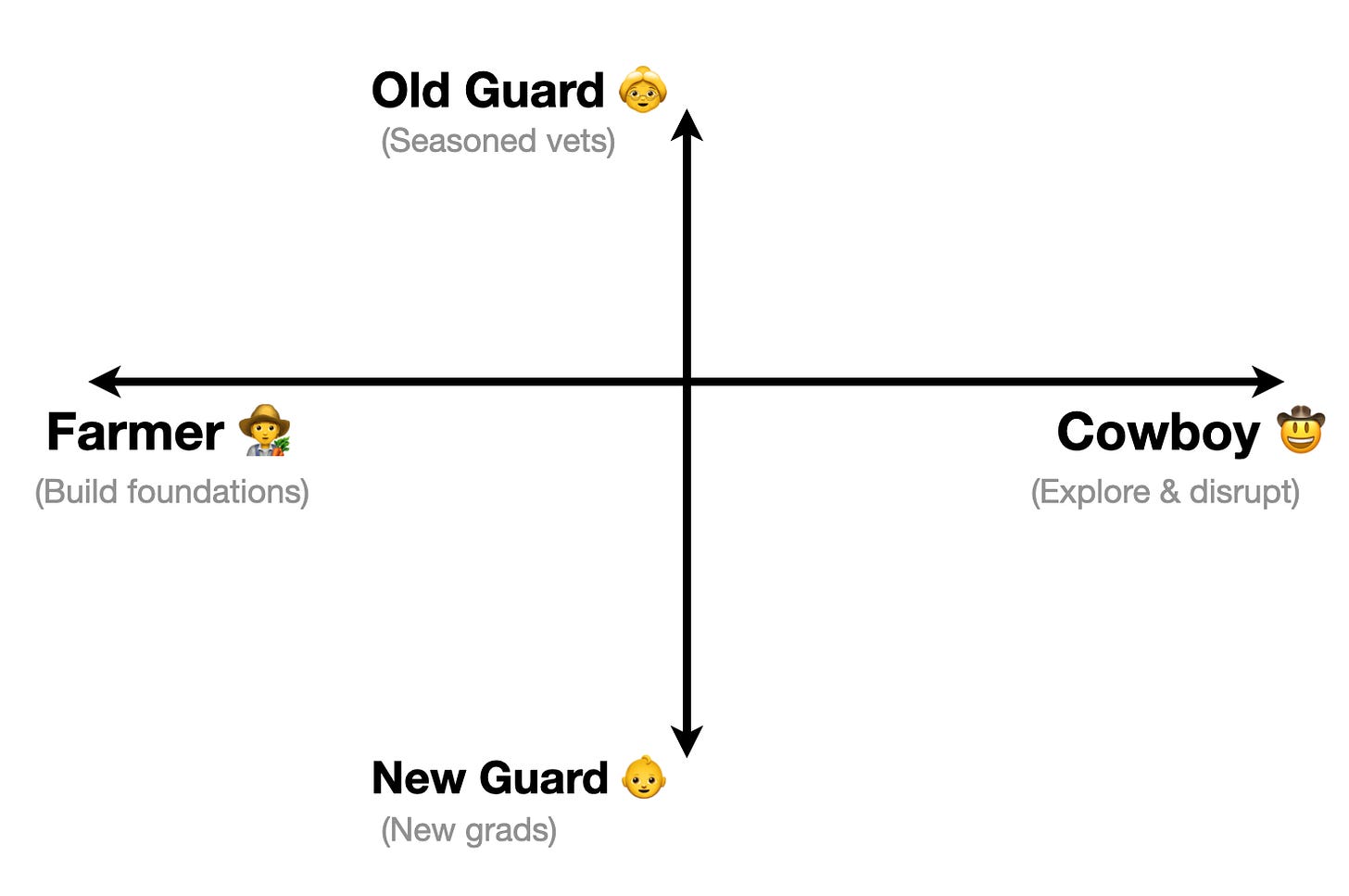
A 'cowboy' thinks outside the box.
'牛仔'跳出框框思考。
They're naturally pushing the boundaries and searching out new territory.
他们天生就在拓边界、找新地盘。
They roam all over the place.
他们四处游走。
The 'farmer' is focused on making sure the cowboys have the resources to keep exploring.
'农夫'则专注于让牛仔有资源继续探索。
They grow food on the land that has already been acquired.
他们在已经拿下的土地上种粮食。
They scale up the operations behind the roving horse-riders.
他们把这些四处策马的人背后的运营规模化。
Without the farmers, the cowboys can't go as far.
没有农夫,牛仔跑不了那么远。
Without the cowboys, the farmers just stay where they are.
没有牛仔,农夫只会原地踏步。
Old Guard & New Guard
In this case, I'm not talking about just the company OGs (founding team, early employees) vs. new hires… I'm talking about industry-level experience: Seasoned vets vs. Wunderkinds.
这里我说的不只是公司元老(创始团队、早期员工)对新人……我说的是行业层面的经验:身经百战的老兵,对上天才少年。
What the old guard brings to the table is raw business experience - the 'I've seen this movie before' instincts to understand how things can go right, but mostly just 1000 ways that things tend to go wrong.
老将带来的是实打实的商业经验——那种'这部电影我看过'的直觉,知道事情怎样能成,但更多是知道事情通常会怎样搞砸的一千种方式。
The new guard is where the AI native instincts really come in.
新锐才是 AI 原生直觉真正发挥的地方。
These are truly people right out of school, who have never worked corporate jobs before.
他们是真正刚出校门、从没在大公司待过的人。
They bring the confident 'well, why don't we just do it this way' perspective that the old guard tends to ignore.
他们带来一种自信的'那我们干脆这么干不就行了'的视角,而这往往被老将忽略。
And now, because of how much AI is changing the fundamentals, they're often right.
而如今,因为 AI 正在颠覆太多底层逻辑,他们经常是对的。
Young Farmers & Old Cowboys
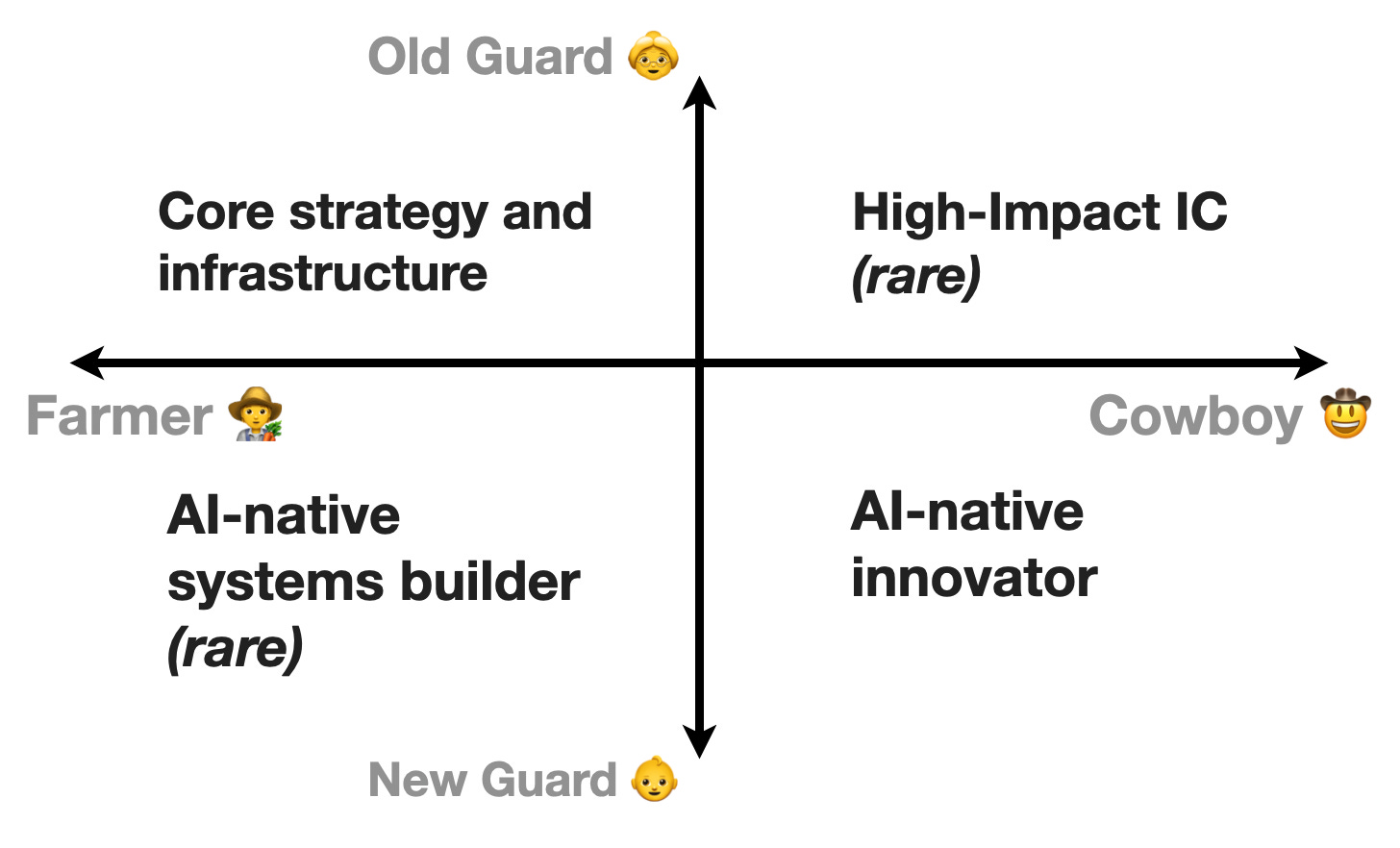
You may notice two areas on the graph that are a bit lighter - what I'd call 'young farmers' and 'old cowboys.'
你可能注意到图上有两块颜色略浅——我把它们叫作'年轻农夫'和'老牛仔'。
The 'young farmers' part is pretty straightforward: The operational infrastructure and scalability components require a lot of context.
'年轻农夫'这一块很好理解:运营基建和可扩展性这些活儿,需要大量的上下文积累。
Having AI-native folks who can completely rethink everything is a huge asset in the innovation and market-facing roles.
在创新和面向市场的岗位上,有一批能把一切彻底重想的 AI 原生员工,是巨大的财富。
But the underlying systems almost always require more planning and experience.
但底层系统几乎总是需要更多的规划和经验。
This is the place where you absolutely do NOT want to move fast and break things.
这恰恰是你绝对不想'快速行动、打破常规'的地方。
The 'old cowboys' part is… actually a bit personal for me.
'老牛仔'这一块……其实对我来说有点私人。
I've always taken a lot of pride in being on the 'cowboy' side of things: staying up with the latest technology, trying out the most innovative stuff.
我一直很自豪自己站在'牛仔'这一边:追最新的技术,试最前沿的东西。
But the reality is that coming up through the previous waves of software and growth means that I'm not literally AI native.
但现实是,我是从前几波软件和增长浪潮里成长起来的,这意味着我并不是严格意义上的 AI 原生。
I wasn't born into it.
我不是在这里面长大的。
Which means that I've got some catching up to do.
这意味着我还有些功课要补。
But I also think that these intersections are where you have the most opportunity for High-impact IC types - enough experience to have an impact and build something scalable, but enough AI literacy (and organizational role freedom) to go chase things down on your own.
但我也认为,这些交叉地带正是最有机会诞生高影响力 IC 的地方——经验足以做出影响、搭起可扩展的东西,同时又有足够的 AI 素养(以及组织角色上的自由度),能自己去把事情追到底。
Which Ones Do You Want? Yes.
For companies at our size, the instinct is usually to hire Farmers.
对我们这个规模的公司,直觉通常是招农夫。
Usually, the cowboys come first (and later, when you hit a new PMF horizon), but the classic move for a scale-up is to put down roots and start harvesting revenue.
通常牛仔会先来(之后当你迈向新的 PMF 阶段时也会再需要),但对一家扩张期公司来说,经典打法是扎下根、开始收割营收。
Farmers love Growth, amirite??
农夫最爱增长,对吧??
But in fast-moving environments, you can't just go all in, in one direction.
但在快速变化的环境里,你不能只往一个方向 all in。
Yes, you do need more farmers.
没错,你确实需要更多农夫。
But you also need to be bringing in lots of cowboys, to keep things moving.
但你同样得引进大量牛仔,好让事情一直往前推。
So, as we're building out teams, we're not just looking for a generic 'marketing specialist' or 'PM for this area.'
所以在搭团队时,我们要找的不是笼统的'市场专员'或'某某领域的 PM'。
As we evaluate talent, we figure out the area and then start thinking about the fit: 'Which quadrant do they need to fall into, to be impactful in this role?
评估人才时,我们先确定领域,然后开始想匹配度:'要在这个岗位上做出影响,他得落在哪个象限?
And most importantly: how do we make sure that there's a good representation in each quadrant on the team, to maintain a healthy tension?'
而最重要的是:我们怎么保证团队里每个象限都有足够的人,来维持一种健康的张力?'
You need all of the different components, plus mutual appreciation across the sectors.
你需要所有这些不同的组成部分,再加上各个板块之间的相互欣赏。
You have to find the right balance: Innovation plus scalability, industry expertise plus willingness to reinvent everything.
你得找到那个平衡点:创新加可扩展性,行业专长加推倒重来的意愿。
How Do You Actually Hire for This?
Unfortunately, you can't just ask people which category they're in.
遗憾的是,你没法直接问人家属于哪一类。
A lot of times, people don't even know themselves!
很多时候,他们自己都不知道!
So it's not something you can screen for in a 30-minute or hour-long interview.
所以这不是靠一场半小时或一小时的面试就能筛出来的。
This is one of the reasons we're really big on case studies and trial work at Lovable.
这也是我们在 Lovable 特别看重案例作业和试岗的原因之一。
Trial work makes a huge difference: Come in and work with us for 2-3 days, and you'll get paid for it.
试岗的作用非常大:来和我们一起干 2-3 天,而且有报酬。
Then, you can kind of see the environment and what it's really like, and we can see you and what you're capable of doing.
这样你能大致感受一下环境、看清它到底什么样,我们也能看到你、看到你能做什么。
This generally works out quite well because you can tell very quickly, once you actually get into the work with someone.
这招通常挺管用,因为一旦真的和一个人一起干活,你很快就能看出来。
We also often start people as contractors and then convert them to full-time, if possible.
我们也经常让人先以合同工身份进来,可能的话再转正。
In fact: even I started out as a contractor.
事实上:连我自己也是从合同工做起的。
I converted to full-time, 6 months in.
干了 6 个月后我才转正。
This was good on both sides: Not just because they were able to test me out, but because I wasn't even sure if I was going to be a good fit in the company.
这对双方都好:不只是因为他们能试用我,也因为我当时都不确定自己适不适合这家公司。
So the contract-to-hire route doesn't have to be limited to just entry-level jobs.
所以'先合同后转正'这条路,不必只用在入门级岗位上。
You should consider applying it as an experiment for bigger positions, as well.
更高的职位,你也可以考虑拿它当个实验来试。
Building the Right Culture
Maybe 'hey, you need different types of people in your org' sounds obvious, but the hard part is getting these different types to work well together.
也许'你的组织里需要不同类型的人'听起来是句废话,但难的是让这些不同类型的人好好协作。
The way to do that mostly comes back to humility.
而做到这一点,很大程度上要回到谦逊。
Which is another thing to hire for.
这也是招人时该看的一点。
But a few things I've noticed for how our org is set up also help.
不过我也注意到,我们组织架构上的一些设置同样有帮助。
(1) Nobody gets internal titles.
(1) 没有人有内部头衔。
The hierarchy is almost entirely flat.
层级几乎完全扁平。
There are the people doing the work, and some Leads, which have a bit more responsibility.
有干活的人,还有一些 Lead,他们责任稍多一点。
And there are department Heads, who have at least 2+ levels underneath them, but there are less heads than I can count on one hand.
再就是部门 Head,他们手下至少有两级以上,但 Head 的数量一只手都数不满。
We're trying to keep everything super flat.
我们尽量让一切保持极度扁平。
Taking titles out of the equation shows the motivations for why people want a big title in the first place.
把头衔这个因素拿掉,就暴露出人们当初为什么想要个大头衔的动机。
Either: (a) Title is an important thing for your ego (which I get… everyone goes through this), or (b) People NEED the title to get work done.
无非两种:(a) 头衔对你的自我很重要(这我懂……人人都会经历这个阶段),或者 (b) 人们需要头衔才能把活干成。
That second type is the structure that creates an environment where the old guard can't collaborate with the new guard.
第二种,正是那种让老将没法和新锐协作的结构。
For example, if I'm the VP of Growth, a new grad would have a hard time doing face-to-face work with me, even if I'm very supportive of it.
举个例子,如果我是增长 VP,一个应届生就很难和我面对面共事,哪怕我非常支持这么做。
I've had to check myself a couple times with this, when new grads are pushing back on things that I think are obvious.
在这件事上我好几次不得不提醒自己——当应届生对我觉得理所当然的东西提出反对时。
It teaches me humility! I love it.
它教会我谦逊!我很喜欢。
It keeps me accountable, and it turns out they're right a lot of the time.
它让我保持担责,而事实证明,他们很多时候是对的。
People with limited experience aren't always right, but they usually have great perspective that is generally suppressed in most organizations.
经验有限的人不总是对,但他们往往有很棒的视角,而这种视角在多数组织里通常都被压制了。
(2) Autonomy and agency as a core value.
(2) 把自主与能动性(agency)当作核心价值观。
At Lovable, everybody can make a decision.
在 Lovable,每个人都能做决定。
They're the ones who are accountable and responsible.
他们就是那个要担责、负责的人。
There are a few exceptions, but in general, decisions don't have to travel up and down a chain of command.
有少数例外,但一般来说,决策不必在层层指挥链里上上下下。
If you can convince one person, you can move forward.
只要你能说服一个人,就能往前推。
It doesn't have to all be top-down, from the Old Guard / senior people.
不必事事自上而下、由老将或资深的人拍板。
Everyone is empowered in their role to own something from end-to-end.
每个人都被赋权,在自己的岗位上端到端地掌管某件事。
You're actually expected to only pull people in when you need to.
而且默认你只在需要时才把别人拉进来。
This creates equality in the org and removes the permissioning, which is so important.
这在组织里创造了平等,也去掉了'层层审批',这一点太重要了。
(3) We appreciate people who are comfy with chaos.
(3) 我们欣赏那些能在混乱中自在的人。
This one is probably harder for the OGs (like me) who are maaaybe a bit addicted to data-backed decisions.
这一条对元老们(比如我)大概更难,我们可能有那么一点点沉迷于数据支撑的决策。
But the tough reality is that when things are evolving this quickly, there will never be enough context or 'alignment' to know for sure what will happen.
但残酷的现实是,当事情变化得这么快,你永远不会有足够的上下文或'对齐',来确定接下来会发生什么。
We need people (whether Farmers or Cowboys) to just call the shot so that everyone else can move forward.
我们需要有人(不管是农夫还是牛仔)直接拍板,好让其他所有人能往前走。
I've been so impressed with my coworkers who create this kind of clarity for the whole org.
那些能为整个组织带来这种清晰的同事,让我特别佩服。
Sure, admit the tradeoffs and show the risks, but we have a shared agreement that waiting for perfect information would keep us in a holding pattern forever.
当然,该承认取舍、该摆出风险,但我们有个共识:等一份完美的信息,只会让我们永远原地打转。
What Should You Do?
Now, what should you do if you're reading this and want to make yourself as hireable as possible?
那么,如果你正在读这篇文章,想让自己尽可能好招,你该怎么做?
My suggestion:
我的建议是:
Step 1: Be honest about where you are, right now. Like I said before, it's shocking to me how few people are aware of where they fit on the chart.
第 1 步:诚实面对你此刻的位置。 就像我前面说的,很少有人清楚自己在这张图上落在哪儿,这让我很吃惊。
Step 2: Lean into your superpowers. Are you naturally more focused on disruption or structure? Do you have tons of industry experience, or do you bring a fresh perspective? Start there.
第 2 步:发挥你的超能力。 你天生更偏向颠覆,还是更偏向结构?你是有大量行业经验,还是带来一种全新视角?从这里入手。
Step 3: Consider where you want to grow. The old guard needs to understand AI-native capabilities, even if they probably shouldn't be bleeding edge. The new guard should work on growing their context window (to use a term that will make sense to them, lol). You should play to your strengths, but understand where gaps might exist, so that you can at least watch out for them.
第 3 步:想清楚你想往哪儿成长。 老将需要理解 AI 原生的能力,哪怕他们大概不必冲在最前沿。新锐则应该努力扩大自己的'上下文窗口'(用个他们能秒懂的说法,哈哈)。你应该发挥长处,但也要清楚差距可能在哪,至少能留个心眼。
Step 4: Appreciate your counterparts. Become BFFs with the other quadrants. You need what they have, they need what you have! You can help each other out, and don't be too proud to ask for feedback and input.
第 4 步:欣赏你的对位者。 和其他象限的人成为铁哥们。你需要他们有的,他们也需要你有的!你们能互相帮衬,别太要面子,该求反馈和意见就去求。
All of this starts with developing enough self-awareness to know where you can be valuable and leaning in there.
这一切的起点,是培养出足够的自我认知,知道自己能在哪里创造价值,然后往那儿使劲。
Companies today are growing so fast that these types of collaborations are absolutely critical.
如今的公司增长得太快,这类协作绝对是关键。
Having this kind of understanding for the structure of different roles helps everyone to appreciate each other more, and thrive in the things where they can offer the most.
对不同角色的结构有这样的理解,能让每个人更欣赏彼此,并在自己最能贡献的地方大放异彩。
Happy trails, y'all!
一路顺风,各位!