SaaS Metrics 2.0 · Definitions
2014 年 7 月 4 日,Skok 把 SaaS Metrics 2.0 主篇里所有指标的精确公式整理成这份"字典页"——CAC 的计算口径、Customer Lifetime 的指数衰减、LTV 的简单/ARPA/Gross Margin/复杂四种版本(其中复杂版由他在 Matrix 的合伙人 Stan Reiss 推导)、Sales Efficiency Gross vs Net、Magic Number 的来源(Scale Ventures)、Net New ARR 的拆解、以及 NRR(Net Revenue Retention)的完整算法。本页带 25 张公式图,全部本地化。
SaaS 字典页里最值得抄走的 10 条公式
-
CAC 早期要做"折扣"调整,不能直接算
"There is a problem with using this formula in the early days, as you may several expensive people in the team that should scale to handle a far number of customers as you grow. In that case, your CAC will be too high."
"I suggest doing a very simple adjustment to the Sales & Marketing expenses to take only a portion of those salaries and expenses in the early days. That will give a better indication of how CAC will look in the future when you are at scale."
早期销售团队是"为规模化预留"的,直接除以新客数 CAC 会虚高。Skok 建议只把当期 S&M 工资和费用的一部分算进去,得到"未来规模下的 CAC"——这是融资讲故事的标准做法。
-
Customer Lifetime = 1 / Churn Rate(指数衰减简化)
"If you start with a cohort of 100 customers and apply a constant churn rate every month, you'll get an exponential decay… Mathematically this can be simplified to the following formula: Customer Lifetime = 1 / Churn Rate."
"If the Monthly customer churn rate is 3%, then the Customer Lifetime will be 1/0.03 which is 33 months. If the Annual customer churn rate is 20%, then the Customer Lifetime will be 1/0.20 which is 5 years."
这是整个 SaaS 公式系统的基石。月流失 3% → 客户平均待 33 个月。年流失 20% → 待 5 年。单位时间要对齐——月用月,年用年。
-
LTV 有四种公式版本,选错会害死你的决策
"In the situation where all customers have roughly the same ARPA, and where there is no expansion revenue expected over the lifetime of a customer, you can use this simple formula."
"However in situations where you have widely differing ARPA across the customer base… a more accurate formula would be [ARPA-based]. To truly get an accurate picture of LTV, it is important to also take Gross Margin into consideration."
四种 LTV:(1)同 ARPA + 无扩展 = ARPA × Lifetime;(2)ARPA 差异大 = sum(ARPA_i)× Lifetime;(3)加 Gross Margin 调整;(4)有扩展的 → Stan Reiss 的复杂公式。用错版本可能让你高估或低估 LTV 几倍。
-
想算"有扩展"的 LTV?用 Stan Reiss 的公式
"I asked my partner, Stan Reiss, to help with the math to calculate LTV in this more complex situation. Here is what he came up with: Variables: a = initial ARPA per month x GM %, m = monthly growth in ARPA per account x GM%, c = Customer Churn Rate %."
"(This formula makes an assumption that revenue increases at a roughly fixed rate every month for the entire lifetime of the customer. That probably doesn't hold true for many SaaS businesses, but the goal is to get a rough idea, not to have the absolute perfect answer.)"
Skok 在 Matrix 的合伙人 Stan Reiss 给出了 ZenDesk 这类"每月固定扩容"场景的 LTV 闭式公式。变量 a、m、c 三个,扩展量 m 是美元数(不是百分比)。是个粗略估算,但能取代纯 spreadsheet 的死算法。
-
Months to Recover CAC 准确算法要加 Gross Margin 调整
"To be perfectly accurate, this should include a Gross Margin adjustment as follows: Months to recover CAC = CAC / (ARPA × Gross Margin %)"
"Months to recover CAC is one of the four key metrics to evaluate the health of a SaaS business. The other three are Growth rate for Net New ARR, Burn Rate and Net Retention Rate (NRR)."
不加毛利调整时算出来是收入回收期,加上毛利才是真实"利润回收期"。Skok 把这个指标列为 SaaS 四大健康指标之一——其他三个:Net New ARR 增长率、Burn Rate、NRR。
-
12 个月的 MTRC 门槛在 2014 之后放宽了
"That guideline was written back in 2011, when it was hard to raise capital. Since then the investment community has realized the power of the SaaS business model, and many SaaS companies have gone public and performed well. As a result, it is now possible to raise much larger amounts of capital, and therefore you can afford to have a longer time to recover CAC than just 12 months."
"In many enterprise businesses, where there is a Land and Expand model, Months to recover CAC can be around 20 months, and the model works fine. In practice, it is very rare to find Months to recover CAC as less than 12."
Skok 自己承认 2011 年定的 12 个月红线已经过时。Land-and-Expand 企业级生意常见 20 个月,只要能融到钱、退出预期好,就能跑通。这个"修订"的承认很有意思——刻舟求剑要不得。
-
Sales Efficiency = 1 时 ≈ MTRC = 12 个月
"If we ignore Gross Margin, a Sales Efficiency of 1, implies that Months to recover CAC is 12 months. As Sales Efficiency drops to 0.5, your Months to recover CAC increases to 24 months."
"I tend to prefer 'Months to recover CAC' as the name of the metric is self-explanatory, which makes everyone clear what it is that you are measuring."
Sales Efficiency 和 MTRC 是同一件事的两种表达:S.E. = 1 ↔ 12 月,S.E. = 0.5 ↔ 24 月。Skok 自己更喜欢 MTRC 这个名字,因为读起来就知道在测什么。
-
Magic Number 是 Scale Ventures 发明的、给公开 SaaS 用的近似
"Scale Ventures came up with the idea of modifying Sales Efficiency to create what they called the Magic Number. This is very similar to Net Sales Efficiency. It replaces Net New ARR in the current quarter, with the increase in GAAP Revenue in the current quarter multiplied by 4."
"Anyone is now able to compute a metric that is now very close to Net Sales Efficiency using data that all public SaaS companies report, and therefore we have a standardized benchmark."
公开 SaaS 公司不公布 ARR——但 GAAP Revenue 公布。Scale Ventures 用 ΔGAAP_Revenue × 4 近似 ARR 增量,把这个除以上季度 S&M 支出,得到一个可横向对比的"魔术数字"。缺点:没考虑毛利,也没区分订阅 vs 服务收入。
-
不要再用旧的 Bookings,改用 Net New ARR
"The answer is that we need to stop looking at Bookings in the old way, and replace it with Net New ARR. This is the most important metric to run a SaaS business by from month to month, quarter to quarter."
"Bookings the total dollar value of all new contracts signed… Since the bookings number might have a mix of different durations (e.g. month-to-month; 6 months; 12 months) this number is not very helpful for understanding the business."
老 Bookings 把月度、半年、年度合同混在一起,数字不可比。Net New ARR = 新增 + 扩展 − 流失,以"年化"为口径,才是 SaaS 公司月度/季度的真实增长尺度。
-
NRR ≥ 120% 是公开 SaaS 公司的常态
"NRR is one of the four most important metrics for evaluating the health of a SaaS business. If you were to look at public SaaS companies, you will find that most are at 120% or higher."
"If your Dollar Renewal Rate is greater than 100%, you have negative churn, which is a very good thing to have achieved… Public company investors understand that this is a very important metric, and pay attention to it in earnings reports."
NRR > 100% = Negative Churn(净负流失)。公开 SaaS 公司多数 ≥ 120%。一个简单的思考方式:一月入组 cohort 一年后还剩 $100k 中的 $90k,但他们又多买了 $20k,所以 NRR = 110%。
Intro & Calculating LTV / CAC
This page is a supplement to the the SaaS Metrics 2.0 blog post.
这一页是 SaaS Metrics 2.0 主篇的配套字典。
It provides detailed definitions for each of the key metrics used in that post.
它给出主篇里每一个核心指标的精确定义。
Unit Economics is a very powerful way to analyze the long term profitability of a SaaS business.
Unit Economics(单位经济学)是分析 SaaS 公司长期盈利能力非常强的一种工具。
I am often asked for the details of how to compute the various elements, such as CAC and LTV.
我经常被问到:CAC、LTV 这些细节具体怎么算?
This post gives the formulae.
这篇文章给出公式。
CAC — Cost to Acquire a Customer
CAC is defined as follows:
CAC 的定义如下:

There is a problem with using this formula in the early days, as you may several expensive people in the team that should scale to handle a far number of customers as you grow.
早期使用这个公式会有问题:团队里可能已经有几个高薪 hire,他们的产能其实是为未来扩张准备的——但现在客户量还小。
In that case, your CAC will be too high.
在这种情况下,你算出来的 CAC 会偏高。
I suggest doing a very simple adjustment to the Sales & Marketing expenses to take only a portion of those salaries and expenses in the early days.
我建议做一个非常简单的调整:早期只把销售和市场费用中的一部分计入。
That will give a better indication of how CAC will look in the future when you are at scale.
这能让你看到"未来规模化后 CAC 大致长什么样"——更有参考价值。
Customer Lifetime
If you start with a cohort of 100 customers and apply a constant churn rate every month, you'll get an exponential decay, as shown in the following graph (which uses a 3% monthly churn rate):
如果一组 cohort 起步有 100 个客户,每月按一个恒定比率流失,衰减会是指数型的——下图用 3% 月流失为例:
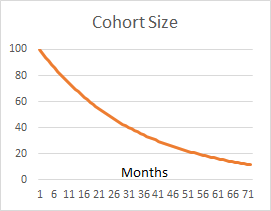
Mathematically this can be simplified to the following formula to find the average Customer Lifetime:
数学上,这条曲线可以化简成下面这个简单公式来求平均"客户生命周期":

Note that if the Customer Churn rate is a monthly % or yearly %, then the Customer Lifetime will be for the same time period.
注意:Churn 率是月度百分比时,Customer Lifetime 就是月数;是年度百分比时,Customer Lifetime 就是年数——单位必须对齐。
Here is a monthly and annual example to illustrate the point:
下面是月度和年度两个例子来说明这一点:
a) If the Monthly customer churn rate is 3%, then the Customer Lifetime will be 1 / 0.03 which is 33 months.
b) If the Annual customer churn rate is 20%, then the Customer Lifetime will be 1 / 0.20 which is 5 years.
a) 月度客户流失率 3% → Customer Lifetime = 1/0.03 = 33 个月。
b) 年度客户流失率 20% → Customer Lifetime = 1/0.20 = 5 年。
Lifetime Value of Customer
For a more detailed blog post dedicated to the topic of how to calculate LTV, see the following blog post: What's your TRUE customer lifetime value (LTV)? – DCF provides the answer.
关于 LTV 怎么算,有一篇更详尽的专文:What's your TRUE customer lifetime value (LTV)? – DCF provides the answer。
The following provides a simple intro to the topic:
下面是对这个话题的一个简单入门:
In the situation where all customers have roughly the same ARPA, and where there is no expansion revenue expected over the lifetime of a customer, you can use this simple formula:
在所有客户 ARPA 大致相同、且预期生命周期内没有 expansion 收入的情况下,可以用这个简单公式:

which can also be expressed as follows:
也可以表达成下面这样:

Once again if ARPA is monthly, the churn rate should be monthly.
再次强调:ARPA 是月度的话,churn 也要用月度。
However in situations where you have widely differing ARPA across the customer base, this would not take into consideration the difference between losing a high value customer versus a low value customer.
但如果你的客户群里 ARPA 差异非常大,上面这个公式就没法区分"丢一个大客户"和"丢一个小客户"的差别。
So a more accurate formula would be:
所以一个更准确的公式是:

To truly get an accurate picture of LTV, it is important to also take Gross Margin into consideration.
想真正算准 LTV,还必须把 Gross Margin(毛利率)考虑进去。

I'm surprised at how often I see a SaaS product architected in a way that means they'll never clear a decent gross margin.
我经常惊讶于:很多 SaaS 产品架构上就决定了它们永远拿不到一个体面的毛利率。
Including GM in the calc is a great way for you to see there is a big lever on LTV/CAC that is worth focusing on.
把 GM 加进 LTV 计算里,你就能看到这是 LTV/CAC 上一根值得发力的大杠杆。
For NetSuite, we've not only calculated LTV/COCA, but also calculated r-squared of each of the components (to see what has driven improvement) and sensitivity analysis on them (to see what might drive it in the future).
在 NetSuite,我们不仅算 LTV/COCA(获客成本),还算每个分量的 R²——看是什么在推动改善;以及对每个分量做敏感性分析——看未来什么可能会推动它。
GM is an important component.
GM 是其中很重要的一项。
More complex case
In the specific situation where you expect ARPA to change over the lifespan of the customer due to expansion revenue, this simple version of the formula will not work.
如果你预期客户的 ARPA 会随生命周期变化(因为有 expansion 收入),前面这个简单公式就不适用了。
We ran into this situation with ZenDesk, where there is a pretty reliable increase in revenue over the life of a customer.
我们在 ZenDesk 就遇到过这种情况——客户生命周期内,收入会比较稳定地增长。
Here's a graph showing what would happen if you had a cohort of 100 customers that initially started paying you $100 a month, but increased their payment by $5 every month. The monthly Customer Churn Rate is 3%:
下面这张图展示了这样一个场景:一组 100 个客户 cohort,起初每月付 $100,之后每月增加 $5;月度客户流失率 3%:
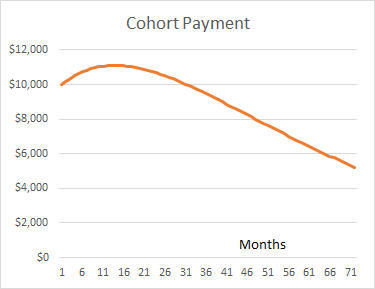
As you can see the expansion revenue initially is greater than the losses from churn, but over time the churn takes over and brings down the value of that cohort.
可以看到:初期 expansion 收入大于流失损失,但随着时间推移,流失逐渐占主导,把 cohort 价值拉下来。
I asked my partner, Stan Reiss, to help with the math to calculate LTV in this more complex situation.
我请了 Matrix 的合伙人 Stan Reiss 帮我推这种更复杂情况下 LTV 的公式。
Here is what he came up with:
他给出的版本如下:
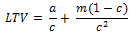
Variables:
a = initial ARPA per month × GM %
m = monthly growth in ARPA per account × GM% (note this is a $ figure, not a percentage)
c = Customer Churn Rate % (in months)
变量:
a = 初始月 ARPA × GM%
m = 每月每账户 ARPA 增长 × GM%(注意:这是美元数,不是百分比)
c = 月度客户流失率 %
(This formula makes an assumption that revenue increases at a roughly fixed rate every month for the entire lifetime of the customer.
(这个公式假设:整个生命周期内,收入每月按一个大致固定的速率增长。
That probably doesn't hold true for many SaaS businesses, but the goal is to get a rough idea, not to have the absolute perfect answer.)
这对很多 SaaS 公司其实不成立——但目标是拿到一个大致估值,不是绝对精确答案。)
But there are other complexities such as as the following:
还有其他更复杂的情况,比如:
· Your churn doesn't follow an exponential decay curve
· Your customers don't follow a simple linear revenue expansion
· 你的流失不遵循指数衰减曲线
· 你的客户不是简单的线性扩展
To handle these more complex cases, please refer to this more detailed post on how to calculate LTV: What's your TRUE customer lifetime value (LTV)? – DCF provides the answer.
要处理这些更复杂的情况,请参考另一篇详细讨论 LTV 的文章:What's your TRUE customer lifetime value (LTV)? – DCF provides the answer。
LTV : CAC Ratio & Months to Recover CAC
LTV : CAC Ratio
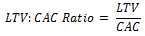
Our guideline for a successful SaaS business is that this number should be higher than 3.
我们对一家成功 SaaS 公司的经验法则是:这个比值应该 > 3。
It is most important to track this metric over time to make sure you're driving improvement.
最重要的是,要随时间追踪这个指标,确认它在改善。
And, look at investment and how it will impact.
同时,看你的投入会怎么影响它。
(The guideline assumes you are using the simpler LTV formula that does not include a Gross Margin adjustment, and that you have a Gross Margin of 80% or higher.)
(这条经验法则假设你用的是不含 GM 调整的简单 LTV 公式,且毛利率在 80% 或以上。)
Months to recover CAC

To be perfectly accurate, this should include a Gross Margin adjustment as follows:
要做到完全准确,应该加上 Gross Margin 调整,如下:

Months to recover CAC gives you a very good sense of how much capital you will burn if you start growing the business.
Months to recover CAC 能让你很清楚地看到:开始扩张生意时你会烧掉多少现金。
The lower this number, the less capital you will consume.
这个数字越低,你消耗的资本越少。
In our guidelines provided in the SaaS Metrics 2.0 Blog post, we suggest that Months to Recover CAC should be less than 12 months.
我们在 SaaS Metrics 2.0 主篇里给出的经验法则是:Months to Recover CAC 应当少于 12 个月。
That guideline was written back in 2011, when it was hard to raise capital.
这条法则写于 2011 年——当时融资还很难。
Since then the investment community has realized the power of the SaaS business model, and many SaaS companies have gone public and performed well.
从那以后,投资圈认识到了 SaaS 商业模式的威力,很多 SaaS 公司也上市并表现良好。
As a result, it is now possible to raise much larger amounts of capital, and therefore you can afford to have a longer time to recover CAC than just 12 months.
所以现在你能融到的资金量大得多——CAC 回收期可以接受比 12 个月更长。
In many enterprise businesses, where there is a Land and Expand model, Months to recover CAC can be around 20 months, and the model works fine.
很多企业级生意是 Land-and-Expand 模式——CAC 回收期 20 个月左右照样跑得通。
In practice, it is very rare to find Months to recover CAC as less than 12.
实际操作中,很少见到 CAC 回收期能压到 12 个月以内。
Months to recover CAC is one of the four key metrics to evaluate the health of a SaaS business. The other three are Growth rate for Net New ARR, Burn Rate and Net Retention Rate (NRR).
Months to Recover CAC 是评估 SaaS 公司健康度的四大核心指标之一。另外三个:Net New ARR 增长率、Burn Rate、Net Retention Rate(NRR)。
If you are able to manage the business to have good values for these metrics, you will know that you are building a healthy SaaS business.
如果你能把这四个指标都管到好的水平上,就能确认自己在建一家健康的 SaaS 公司。
Sales Efficiency & Magic Number
Sales Efficiency
Sales Efficiency and the "Magic Number" metrics are different ways of evaluating pretty much the same thing as Months to Recover CAC.
Sales Efficiency 和 "Magic Number"——它们和 Months to Recover CAC 衡量的几乎是同一件事,只是表达方式不同。
The thought process behind both of these metrics is to figure out how efficient is a business's sales and marketing spend.
这两个指标背后的思考都是:这家公司在销售和市场上的支出有多高效?
To do that these metrics ask the question: for every dollar of spend on sales and marketing, how much new revenue does that bring in?
它们用同一个问题来衡量:每花 1 美元销售市场费用,带来多少新增收入?
There are two versions of Sales Efficiency, Gross and Net.
Sales Efficiency 有两个版本:Gross(总)和 Net(净)。
Gross Sales Efficiency simply looks at Gross New ARR (which does not include churn), while Net Sales Efficiency measures Net New ARR, which is reduced by Churn.
Gross Sales Efficiency 只看 Gross New ARR(不算流失);Net Sales Efficiency 用 Net New ARR(扣掉流失之后)。
Here are the two formulae:
两个公式如下:

Gross New ARR = New ARR from new customers + Expansion ARR from existing customers.
Gross New ARR = 新客户带来的 New ARR + 存量客户带来的 Expansion ARR。
You could think of this as the output from sales and marketing without paying any attention to how well the company does at retaining and growing those customers.
你可以把它理解为:销售和市场的"产出"——完全不考虑公司在留存和扩展这些客户上做得好不好。
We use the prior quarters spend on sales and marketing with the thought that there is likely to be a delay between the spending of money and effort on sales and when the deal closes.
我们用上一季度的销售市场支出——因为花钱、做销售动作和真正成交之间往往有时间差。
However if your business has a short sales cycle you could use the same quarter's sales and marketing spend.
但如果你的销售周期很短,可以直接用同一季度的 S&M 支出。

Net New ARR = New ARR from new customers + Expansion ARR from existing customers – Churned ARR.
Net New ARR = 新客户 New ARR + 存量客户 Expansion ARR − 流失 ARR。
So Net Sales Efficiency measures not just Sales and Marketing, but also how effective the company is at retaining and growing those customers.
所以 Net Sales Efficiency 不只衡量销售市场,还衡量公司在留存和扩展客户上做得有多好。
The shortcoming of Sales Efficiency is that it does not take into consideration Gross Margin %.
Sales Efficiency 的一个短板,是它没考虑毛利率。
A business with a high gross margin of say 80% is a dramatically better business than a business with the same Sales Efficiency number but a Gross Margin % of only 40%.
一家毛利 80% 的公司,跟一家 Sales Efficiency 数字相同但毛利只有 40% 的公司——前者好得多。
The Relationship between Sales Efficiency and Months to recover CAC
If we ignore Gross Margin, a Sales Efficiency of 1, implies that Months to recover CAC is 12 months.
忽略毛利的话,Sales Efficiency = 1 意味着 Months to recover CAC = 12 个月。
As Sales Efficiency drops to 0.5, your Months to recover CAC increases to 24 months.
Sales Efficiency 降到 0.5,Months to recover CAC 就升到 24 个月。
I tend to prefer "Months to recover CAC" as the name of the metric is self-explanatory, which makes everyone clear what it is that you are measuring.
我个人更喜欢 "Months to recover CAC" 这个名字——它本身就是自解释的,大家一听就知道你在测什么。
It also has one other advantage, which is that it takes into consideration Gross Margin %.
它还有另一个优势:加 GM 调整版本能把毛利考虑进去。
Magic Number
The one problem with both Months to recover CAC and Sales Efficiency is that public SaaS companies do not reveal these metrics.
Months to recover CAC 和 Sales Efficiency 这两个指标都有一个问题:公开上市的 SaaS 公司不会披露它们。
Given that it would be nice to find a way to create a standardized metric that could be used to benchmark all SaaS companies, Scale Ventures came up with the idea of modifying Sales Efficiency to create what they called the Magic Number.
既然想要一个能对所有 SaaS 公司做横向对比的标准化指标,Scale Ventures 就改造 Sales Efficiency 创造了他们称之为 Magic Number 的指标。

This is very similar to Net Sales Efficiency.
这跟 Net Sales Efficiency 非常相似。
It replaces Net New ARR in the current quarter, with the increase in GAAP Revenue in the current quarter multiplied by 4 to bring it closer to ARR (which is an annual number, not a quarterly number).
它把"当季 Net New ARR"替换成"当季 GAAP Revenue 增量 × 4"——因为 ARR 是年化数字,而季度收入要 × 4 才大致对应。
Anyone is now able to compute a metric that is now very close to Net Sales Efficiency using data that all public SaaS companies report, and therefore we have a standardized benchmark.
这样任何人都能用公开 SaaS 公司披露的数据,算出一个非常接近 Net Sales Efficiency 的指标——于是我们就有了标准化的横向对比基准。
There are two shortcomings of the Magic Number that are worth knowing:
Magic Number 有两个值得知道的短板:
1. It does not take into consideration Gross Margin %. We have already pointed out that if you have low gross margins, you really need to have much higher sales efficiencies to make up for that.
1. 它没考虑毛利率。我们前面提过——毛利低的话,你需要远高的销售效率才能补回来。
2. It does not take into consideration the mix between Subscription Revenue and Services Revenue, which is far less valuable, and typically lower margin.
2. 它没区分订阅收入和服务收入——后者价值低得多、毛利也通常低很多。
The Metrics to Help Understand Bookings
In a traditional, non-SaaS, software business, Bookings are one of the most important metrics.
在传统的、非 SaaS 的软件生意里,Bookings 是最重要的指标之一。
However it turns out that in a SaaS business, you need to look closely at what is the right way to measure Bookings.
但在 SaaS 生意里,Bookings 怎么衡量才合适,需要仔细推敲。
To understand the nature of the problem, let's say that in one month we sign two deals: both sign up for the same product, at $1,000 per month, but one signs up for one month commitment, and the other signs up for 12 months.
要理解问题本质,设想这样一个例子:某月签了两单——都是 $1,000/月的同一个产品,但一个客户只签 1 个月,另一个签 12 个月。
In that situation, how should you compute Bookings?
这种情况下,Bookings 怎么算?
An interesting thing can happen with those same two customers: the customer who signed up for only one month at a time, might stay with you for four years, but the customer who signed up for one year, might leave at the end of that one year.
这两个客户之后可能发生意想不到的事:那个按月签的客户可能跟你待 4 年;而那个一次性签了 12 个月的客户,可能合同到期就走。
So what initially looked like the more valuable booking turns out over time to be the less valuable booking.
所以"看起来更有价值"的那单,长期来看反而价值更低。
The answer is that we need to stop looking at Bookings in the old way, and replace it with Net New ARR.
答案是:别再按老办法看 Bookings——用 Net New ARR 来替代它。
This is the most important metric to run a SaaS business by from month to month, quarter to quarter.
这是 SaaS 公司月度、季度运营时最重要的指标。
It takes in to consideration most of the key elements that you need to drive to grow your business:
它把你推动业务增长所要关注的大部分核心要素都考虑了进去:
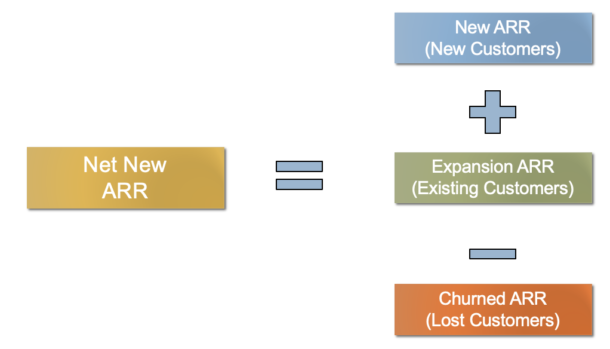
Net New ARR is the sum of the following three components:
Net New ARR 由下面三个分量之和构成:
12 个核心定义 · Definitions Table
-
MRR月度经常性收入
The Monthly Recurring Revenue at the end of each month. Computed by taking the MRR from the previous month and adding Net New MRR.
每月月末的经常性收入。= 上月 MRR + 当月 Net New MRR。
-
ARR年化经常性收入
Annualized Run Rate = MRR × 12. ARR is annual run-rate of recurring revenue from the current installed base. This is annual recurring revenue for the coming twelve months if you don't add or churn anything.
ARR = MRR × 12。代表当前存量客户的年化经常性收入——也就是"未来 12 个月,如果不增不流,你能从现有客户身上获得的经常性收入"。
-
ACV年合同价值
Annual Contract Value of a subscription agreement.
订阅合同在 12 个月窗口内的价值。
-
New ARR新增 ARR
The increase in MRR from new customers in the current month.
当月新客户带来的 MRR 增量(年化)。
-
Churned ARR流失 ARR
The lost MRR from churning customers in the current month.
当月流失客户带走的 MRR(年化)。
-
Expansion ARR扩展 ARR
The increase in MRR from expansion in your installed base in the current month.
当月存量客户扩容/升级带来的 MRR 增量(年化)。
-
Net New ARR净新增 ARR
Net New ARR = New ARR + Expansion ARR − Churned ARR. This is the sum of the three different components that will change MRR during each month.
Net New ARR = New ARR + Expansion ARR − Churned ARR。这是当月推动 MRR 变化的三个分量之和。
-
Bookings签单总额
The total dollar value of all new contracts signed. Usually taken as an annualized number even if the contract period is longer than one year. Since the bookings number might have a mix of different durations (e.g. month-to-month; 6 months; 12 months) this number is not very helpful for understanding the business.
所有新签合同的美元总和。通常按年化看(即便合同周期比一年长)。因为里面可能混着月度、6 个月、12 个月各种周期的合同,这个数对理解业务帮助不大。
-
Billings账单
Billings is the amount that you have invoiced that is due for payment shortly.
你已经开出账单、即将到期收款的金额。
-
Revenue已确认收入
Revenue is amount of money that can be recognized according to accounting policy. Even if it is paid for upfront, usually subscription revenue can only be recognized ratably over time as the service is delivered. If more money has been paid than can be recognized, the difference goes into a balance sheet item called Deferred Revenue.
根据会计准则可以确认的收入。即使客户预付,订阅收入通常只能随服务交付按比例分期确认。已收金额超过可确认部分,差额进资产负债表的 Deferred Revenue(递延收入)。
-
Average Contract Length平均合同期
Assuming a mix of different contract lengths, this gives you the average duration in months or years.
混着各种合同周期时,这给你一个平均周期(月或年)。
-
Months up Front预付月数
Average of months (or years) of payment received in-advance with new bookings. Getting paid in advance has a big positive impact on cash flow. This metric has been used at both HubSpot and NetSuite in the past as a way to incent sales people to get more paid up front.
新签客户平均预付了多少个月(或年)的钱。预付对现金流有巨大正向影响。HubSpot 和 NetSuite 都用过这个指标来激励销售争取更多预付。
To really understand what is going on in your SaaS Business, you should look at the following components:
要真正搞清楚你 SaaS 公司里发生了什么,该看的是下面这几个分量:
a) What happened with new customers:
· New ARR from new customer contracts
a) 新客户那边发生了什么:
· 新客户合同带来的 New ARR
b) What happened in your installed base:
· Renewals
· Churned ARR
· Expansion bookings
b) 存量客户那边发生了什么:
· 续约(Renewals)
· 流失 ARR
· 扩展签单
The sum of all of the above:
· Net New ARR
三者之和:
· Net New ARR
Bookings, Billings and Revenue — An Example
Since there can be some confusion around the difference between bookings, billings and revenue, here is a simple example to help clarify them:
Bookings、Billings、Revenue 之间的差别经常让人困惑——下面这个简单例子能把它们讲清楚:
Imagine you signed a new contract with a customer with a one year term, specifying that you provide your service to them for $1,000 per month, with an upfront payment of six months:
假设你跟一个客户签了 1 年合同——$1,000/月,客户预付 6 个月:
· Your bookings would be $12,000 (the entire contract value)
· You would bill $6,000 in the first month, then $1,000 per month from the seventh month onwards.
· You would recognized $1,000 in revenue for each month of the contract. (This is dictated by GAAP accounting policy.)
· Bookings = $12,000(整个合同价值)
· 第 1 个月开 $6,000 账单,第 7 个月开始每月开 $1,000
· Revenue 每月只确认 $1,000——共 12 个月(GAAP 会计准则规定)
For the example above, the balance sheet and income statement impact of these items is as follows:
上面这个例子里,这些项目对资产负债表和利润表的影响如下:
· Bookings do not affect either the balance sheet or the income statement.
· Bookings 既不影响资产负债表,也不影响利润表。
· When you bill $6,000 in the first month, but can only recognize $1,000 in revenue (income statement), and the other $5,000 goes into deferred revenue on the balance sheet (a liability).
· 第一个月开了 $6,000 账单,但 revenue 只能确认 $1,000(进利润表)——另外 $5,000 进资产负债表的 Deferred Revenue(一个负债项)。
· Each month thereafter until another $1,000 can be recognized as revenue (income statement), and that reduces the deferred revenue liability on the balance sheet.
· 之后每个月,$1,000 转成 revenue(进利润表),同时资产负债表上的 Deferred Revenue 负债减少 $1,000。
The Metrics for Churn (Renewals)
The following shows the metrics to understand Churn:
下面是理解流失(Churn)相关的指标:
-
# of new Customers新客户数
The number of new customers added this month.
本月新增的客户数。
-
# of churned Customers流失客户数
The number of customers lost due to churn this month.
本月因流失失去的客户数。
-
Net New Customers净新增客户数
Net New Customers = # of new Customers − # of churned Customers. This is the net number of new customers added once lost customers due to churn has been taken into account.
Net New Customers = 新客户数 − 流失客户数。这是扣除流失后净新增的客户数。
-
% Customer Churn客户流失率 %
Lost customers / prior month total customers, expressed as a percentage.
流失客户数 / 上月客户总数,百分比表示。
-
% MRR ChurnMRR 流失率 %
Defined as lost revenue due to churned customers as a percentage of total recurring revenue. (See below for a description of why this is different to % Customer Churn.)
因客户流失损失的收入 / 总经常性收入,百分比表示。(为什么和"客户流失率"不同,见下方说明。)
-
% MRR ExpansionMRR 扩展率 %
Defined as the expansion revenue from existing customers as a percentage of total revenue.
存量客户带来的扩展收入 / 总收入,百分比表示。
-
% Net MRR Churn净 MRR 流失率 %
This is the number that will go negative if the Expansion revenue from existing customers starts to outstrip the lost revenue from churn. Getting to negative Net MRR Churn is a great goal for a SaaS company.
当存量客户的 expansion 收入超过流失损失时,这个数会变成负数。让 Net MRR Churn 变负,是 SaaS 公司一个很棒的目标。




Customer Renewal Rate
It can be confusing to look at both your renewal rate (which should be just 1 - Churn) in addition to churn.
既看续约率(理论上 = 1 − Churn)又看 Churn,听上去有点冗余。
However in a model where you have yearly contracts being renewed, the two numbers can actually be different.
但在年度合同续约的模式下,这两个数其实可能不一样。
For example, in the early days of a startup, you might have low churn because many of your customers have not yet reached the point where they could drop your service because of the length of their contract.
举个例子:创业公司早期 Churn 可能很低——因为合同周期的关系,很多客户还没到能取消的时间点。
In that situation, your churn number will not accurately predict what is really going to happen when you reach steady state.
这种情况下,Churn 数字没法准确预测达到稳态后真正会发生什么。
So a better number to look at is how many of your customers are renewing at the point where their contract expires.
所以更好的指标是:合同到期的那些客户里,有多少续约了。
That is what this number measures.
这正是 Customer Renewal Rate 测的东西。
When you reach steady state, this number should be equal to 1 − % Customer Churn.
稳态下,这个数应该等于 1 − Customer Churn %。

Gross Dollar Renewal Rate
Similar to the number above, but instead of looking at the number of customers, it looks at the dollar value of the renewed contracts.
和上面那个类似,但不是看客户数,而是看续约合同的美元价值。
It's important to look at both, as they each tell an useful part of the story.
两个数都要看——它们各自讲故事中的一部分。
If you were losing a lot of customers, you'd want to know why.
如果你丢了大量客户,你会想搞清楚为什么。
Similarly, if you were only losing a few customers, but they were your biggest $ value customers, you'd also want to know that as well.
同样地,如果你只丢了少数客户、但都是金额最大的——你也会想知道。

NRR (Net Revenue Retention)
also referred to as: DRR (Net Dollar Renewal Rate)
也叫:DRR(Net Dollar Renewal Rate,净美元续约率)

Similar to the metric above, but also takes into consideration Expansion MRR:
和上面那个 Gross Dollar Renewal Rate 类似,但额外把 Expansion MRR 考虑进去:
If your Dollar Renewal Rate is greater than 100%, you have negative churn, which is a very good thing to have achieved.
如果你的 Dollar Renewal Rate > 100%,就实现了 negative churn——非常了不起的成就。
Example: If you are looking at NRR on an annual basis, another way to think about what NRR represents, is to think of a specific month's cohort (e.g. the January cohort).
例子:按年度看 NRR 时,可以把它想成"某一个月的 cohort"(比如 1 月 cohort)。
As an example, let's say that at the end of January the revenue from this cohort is $100k.
假设 1 月底,这个 cohort 贡献的收入是 $100k。
A year later, you will have lost some customers, (for example let's say $10k of that cohort's revenue), but the remaining customers have also purchased $20,000 more from you (Expansion MRR).
一年之后,你会丢掉一些客户(比如说这个 cohort 损失了 $10k 收入),但留下的客户又向你多买了 $20k(Expansion MRR)。
So we will have $110k of revenue left from that January cohort a year later.
所以一年后,这个 1 月 cohort 还剩 $110k 的收入。
This means that our NRR is equal to 110%.
也就是说,NRR = 110%。
NRR is one of the four most important metrics for evaluating the health of a SaaS business.
NRR 是评估 SaaS 公司健康度的四大核心指标之一。
If you were to look at public SaaS companies, you will find that most are at 120% or higher.
看公开上市的 SaaS 公司,你会发现大多数都在 120% 或更高。
Public company investors understand that this is a very important metric, and pay attention to it in earnings reports.
公开市场投资人非常清楚这个指标的重要性,会在财报里盯着它看。
If your NRR is 120%, investors understand that if you stopped investing any dollars in acquiring new logos, but simply focused on expanding your current base, your revenue would still grow by 20% per year — a wonderful position to be in.
如果你的 NRR = 120%,投资人就明白:你停止投入任何获取新客户的钱,只专注扩展存量客户,收入仍然会每年增长 20%——这是非常好的状态。